

A tray of muffins, a carton of eggs, and a neatly arranged set of toy cars all have something in common: they can show an array. An array is a way to organize objects into equal rows and columns. Building arrays helps children see equal groups and take their first steps toward understanding multiplication.
With a few everyday objects and a little space, you can turn counting practice into a hands-on math activity.
What Is an Array?
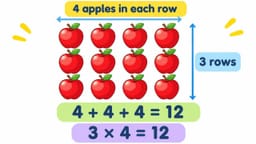
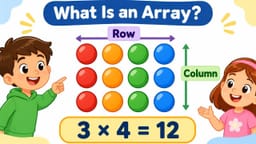
An array is an arrangement of objects in straight rows and columns. Every row has the same number of objects, and every column has the same number of objects.
- Rows go across, from side to side.
- Columns go up and down.
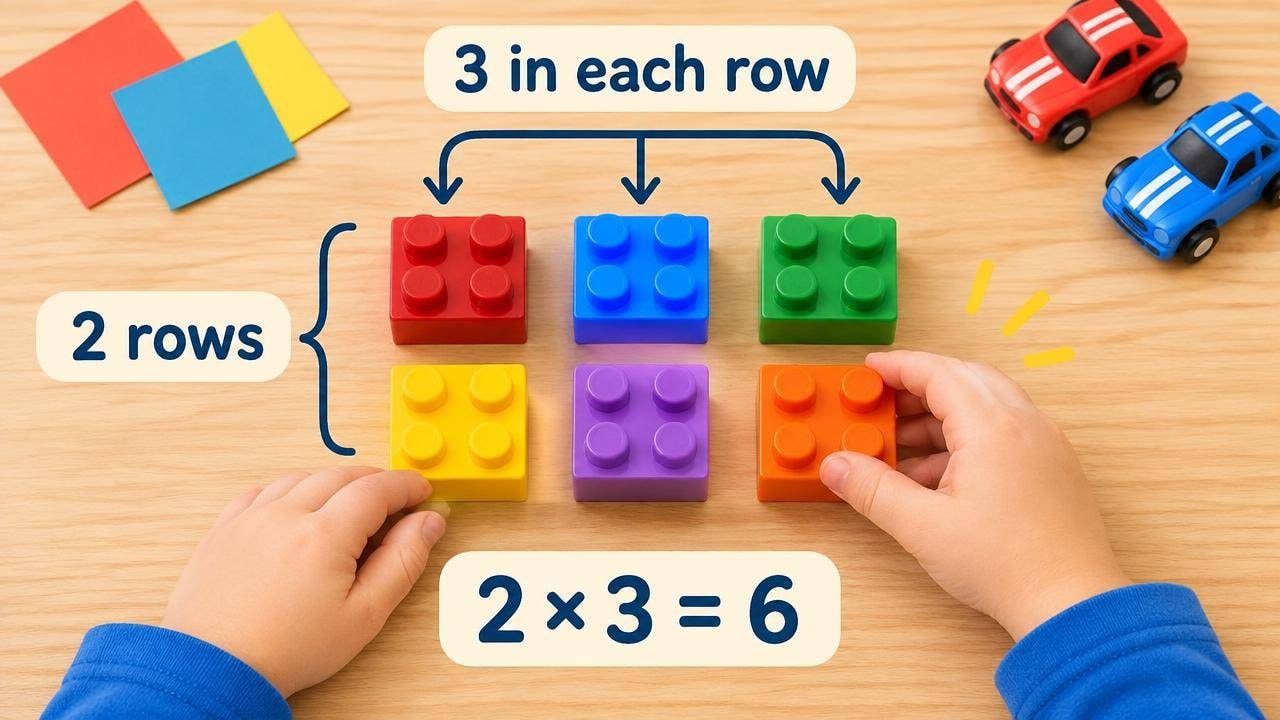
For example, place six blocks in two rows with three blocks in each row. You have made an array with 2 rows and 3 columns.
An array is more than a collection of objects. Its equal rows and columns help us see how many there are.
Gather Everyday Objects
Choose objects that are easy to move and similar in size. You do not need special math equipment.
- Building blocks
- Large toy counters
- Crayons
- Toy cars
- Paper squares
- Plastic cups
Work on a table, a tray, or a clear patch of floor. Use objects that are appropriate for the child's age, and avoid small items if they could be a choking risk.
Build Your First Array
Start with Two Rows of Three
Use six blocks for this first activity. Keep the numbers small so children can focus on the arrangement.
- Place three blocks in a straight row.
- Make another row of three blocks underneath the first row.
- Line up the blocks so each block in the top row has a block directly below it.
- Point to each row and say, Two rows, with three blocks in each row.
- Count all the blocks to check that there are six.
Next, look at the columns. There are 3 columns, with 2 blocks in each column. The same array can be described using either rows or columns.
Ask Questions That Draw Attention to the Structure
- How many rows did you build?
- How many blocks are in each row?
- Does every row have the same number?
- How many columns can you see?
- How many blocks are there altogether?
Encourage children to point as they explain. Saying two rows of three connects the arrangement to the idea of equal groups.
Connect Arrays to Addition and Multiplication
Begin with Equal Groups
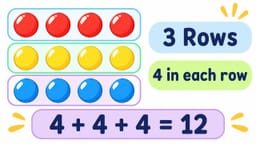
Each row in the block array is a group of three. Because there are two equal rows, children can add:
3 + 3 = 6
This is called repeated addition: adding the same number more than once.
Introduce the Multiplication Sentence
For this activity, write the number of rows first and the number of objects in each row second:
2 × 3 = 6
Read this as two groups of three equals six. The multiplication sign, ×, helps us write an equal-groups idea in a shorter way.
Children do not need to memorize multiplication facts to begin exploring arrays. Building, describing, and counting are the main goals.
Try More Everyday Array Activities
Park Toy Cars in Equal Rows
Make a pretend parking lot with 3 rows of 2 cars. Leave a little space between the rows so they are easy to see.
- Rows: 3
- Cars in each row: 2
- Repeated addition: 2 + 2 + 2 = 6
- Multiplication: 3 × 2 = 6
Ask, If every row has two cars, how many cars are parked altogether?
Arrange Paper Squares
Place paper squares in 2 rows of 4. Invite the child to check that the rows are equal and the columns line up.
- Repeated addition: 4 + 4 = 8
- Multiplication: 2 × 4 = 8
Then ask the child to rearrange the same eight squares into 4 rows of 2. Count again to confirm that the total is still eight.
Set Up a Cup Display
Arrange nine plastic cups in 3 rows of 3. This array has the same number of rows and columns.
- Repeated addition: 3 + 3 + 3 = 9
- Multiplication: 3 × 3 = 9
Ask the child to describe the array before counting the cups.
Turn an Array and Notice What Changes
Build an array with 2 rows of 3 objects on a tray. Turn the tray a quarter turn. Now the array has 3 rows of 2 objects.
No objects were added or taken away, so the total stays six:
- 2 × 3 = 6
- 3 × 2 = 6
Ask, What changed? What stayed the same? This gives children an early way to see that switching the order of the factors does not change the total.
Spot and Fix an Array
Sometimes an arrangement looks almost like an array but has a missing or extra object. These examples make useful puzzles.
The Missing-Object Puzzle
- Build three rows of three blocks.
- Remove one block from the last row.
- Ask, Do all the rows still have the same number of blocks?
- Invite the child to repair the array.
Explain that equal rows are important. An arrangement with rows of three, three, and two is not a complete rectangular array.
Common Mix-Ups to Explore
- Confusing rows and columns: Trace a row from side to side, then trace a column up and down.
- Counting one object twice: Touch each object once, moving along one row at a time.
- Making unequal rows: Compare each row with the first row and adjust the objects.
- Leaving columns uneven: Slide objects into straight lines so the structure is easier to see.
Adjust the Challenge
For Children Who Need More Support
Start with two rows of two or two rows of three. Build the first row together, then ask the child to make a matching row underneath it. Let the child count each object before introducing an addition or multiplication sentence.
For Children Ready for More
Give the child twelve objects and ask, Can you make more than one array using all of these? Possible arrangements include:
- 1 row of 12
- 2 rows of 6
- 3 rows of 4
- 4 rows of 3
- 6 rows of 2
- 12 rows of 1
Explain that a single row or a single column can also be an array. Invite the child to describe each arrangement and check that all twelve objects are used.
Look for Arrays Around You
Once children have built arrays, go on an array hunt. Look for objects arranged in complete, equal rows and columns.
- A full egg carton
- A muffin tray
- Square tiles on a wall
- Windowpanes in a rectangular window
- Seats arranged in equal rows
Ask, How many rows are there? How many things are in each row? How could we find the total? Check the arrangement carefully: not every group of objects is an array.
A Quick Check for Understanding
Give the child eight objects and say, Build two equal rows using all eight objects.
Then ask the child to:
- Point to the two rows.
- Tell how many objects are in each row.
- Count the total.
- Describe the array as two rows of four.
- If ready, connect it to 4 + 4 = 8 and 2 × 4 = 8.
A child who can build and explain the array is developing an understanding of equal groups, even if the multiplication symbol is still new.
Concluding Takeaways
Everyday objects make multiplication visible. By arranging blocks, cars, cups, or paper squares into equal rows and columns, children can explore how equal groups form a total.
- Build first: Use small numbers and movable objects.
- Describe the structure: Name the rows, columns, and objects in each row.
- Connect the ideas: Move from counting to repeated addition and then to multiplication.
- Keep exploring: Turn arrays, fix incomplete ones, and look for examples in daily life.
A simple invitation such as Can you make three equal rows? can begin a meaningful conversation about multiplication.