

Introduction: A Neat Way to Count
Imagine a tray of muffins arranged in straight rows. You could count every muffin one at a time. But when each row has the same number of muffins, you can count equal groups instead!
An array is an arrangement of objects in rows and columns. Arrays help us see equal groups, write repeated addition sentences, and begin to understand multiplication.
What Makes an Array?
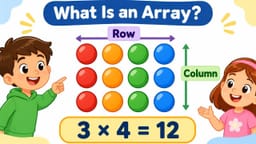
In a rectangular array, the objects form straight rows and columns. Each row has the same number of objects, and each column has the same number of objects.
- Rows go across, from side to side.
- Columns go up and down.
Look at This Array
● ● ● ●
● ● ● ●
● ● ● ●
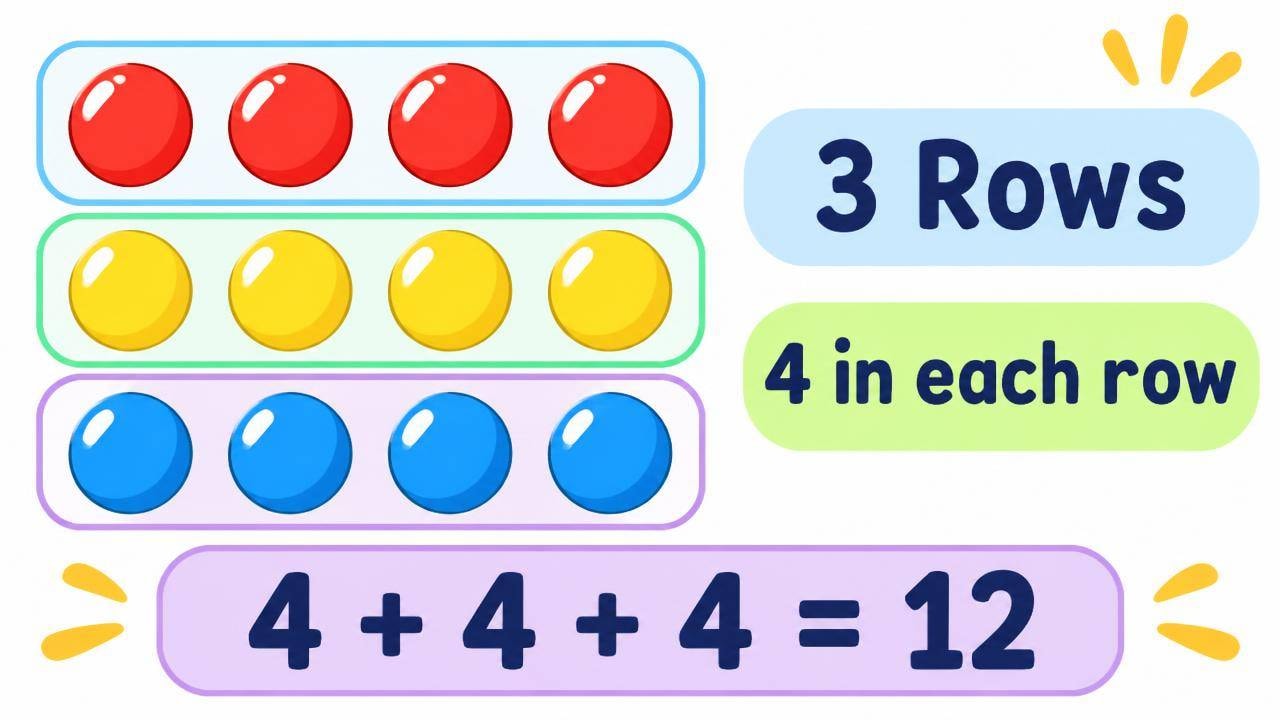
This array has 3 rows with 4 dots in each row. It also has 4 columns with 3 dots in each column.
Before counting, ask: Are the rows equal? Are the dots lined up in columns? Here, the answer to both questions is yes.
Count Equal Rows with Repeated Addition
Repeated addition means adding the same number more than once. In an array, each row can be one equal group.
Example: Three Rows of Four
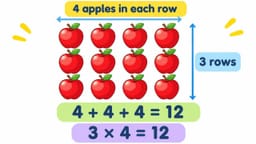
Look again at the dot array. There are 4 dots in the first row, 4 in the second row, and 4 in the third row.
4 + 4 + 4 = 12
There are 12 dots altogether. Each 4 in the addition sentence stands for one row.
Count the rows to find how many groups there are. Count the objects in one row to find how many are in each group.
A Simple Counting Routine
- Find the rows.
- Count how many rows there are.
- Count the objects in one row.
- Add that number once for each row.
- Say how many objects there are altogether.
Use Skip Counting to Find the Total
Skip counting can help you add equal groups. For 3 rows of 4 dots, count 4, 8, 12. Touch or point to one whole row each time you say a number.
- After the first row, you have counted 4 dots.
- After the second row, you have counted 8 dots.
- After the third row, you have counted 12 dots.
The last number tells you the total. You can check by counting every dot one at a time.
Count by Columns, Too
You can count the same array using columns instead of rows.
● ● ● ●
● ● ● ●
● ● ● ●
There are 4 columns with 3 dots in each column. The repeated addition sentence is:
3 + 3 + 3 + 3 = 12
Counting by rows gives 4 + 4 + 4 = 12. Counting by columns gives 3 + 3 + 3 + 3 = 12. The groups look different, but the total stays the same because no dots have been added or taken away.
Try More Array Examples
Example 1: Toy Cars
Sam puts toy cars in 2 rows of 5. How many cars are there?
Each row has 5 cars, so add 5 twice:
5 + 5 = 10
Sam has 10 toy cars.
Example 2: Stickers
A sticker sheet has 4 rows of 2 stickers. How many stickers are there?
Add 2 once for each of the 4 rows:
2 + 2 + 2 + 2 = 8
There are 8 stickers. You can also skip count: 2, 4, 6, 8.
Example 3: Missing Objects
A tray has 3 spaces in each row. One row holds 3 muffins, but another row holds only 2 muffins.
These muffins do not form a complete rectangular array because the rows are not equal. You can count them with 3 + 2 = 5, but this is not repeated addition of equal rows.
Build Your Own Array
Use counters, blocks, or small paper circles.
- Place 3 counters in a straight row.
- Make another row of 3 counters underneath it.
- Line up the counters so they form straight columns.
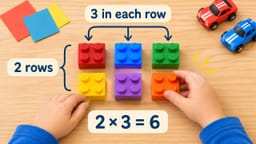
- Say, “I made 2 rows of 3.”
- Write the repeated addition sentence: 3 + 3 = 6.
Now add one more row of 3 counters. Your new array has 3 rows of 3. Its addition sentence is 3 + 3 + 3 = 9.
A First Step Toward Multiplication
Multiplication is another way to describe equal groups. For example, 3 groups of 4 can be written as 3 × 4 = 12. The symbol × means “times.”
The array helps us see what this means: 3 equal rows, with 4 objects in each row. Repeated addition shows the same total: 4 + 4 + 4 = 12.
You do not need to memorize multiplication facts yet. Start by seeing the equal groups and explaining how you counted them.
Practice: Look, Draw, and Add
- Draw 2 rows of 3 dots. Write an addition sentence to find the total.
- Draw 3 rows of 5 dots. How many dots are there altogether?
- An array has 4 rows of 2 buttons. How many equal row groups are there? How many buttons are in each group?
- Mia writes 4 + 4 + 4 = 12 for an array. If each 4 represents a row, how many rows does her array have?
Check Your Thinking
- Question 1: 3 + 3 = 6. There are 6 dots.
- Question 2: 5 + 5 + 5 = 15. There are 15 dots.
- Question 3: There are 4 equal row groups, with 2 buttons in each group. There are 8 buttons altogether.
- Question 4: Mia's array has 3 rows because there are three 4s in her addition sentence.
Takeaways
- An array arranges objects in equal rows and columns.
- Rows go across, and columns go up and down.
- Repeated addition adds the same number once for each equal group.
- Skip counting can help you find the total.
- Arrays and repeated addition help you understand multiplication.
The next time you see a muffin tray, a sticker sheet, or neatly arranged toys, look for equal rows. Tell someone how many groups you see, how many objects are in each group, and how you can add to find the total.