

Imagine lining up toy cars in neat rows. If every row has the same number of cars, you have made an array! Arrays help us see equal groups, count efficiently, and understand what multiplication means.
What Is an Array?
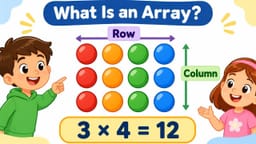
An array is an arrangement of objects in equal rows and columns. A row goes across from left to right. A column goes up and down.
For an arrangement to be an array, every row must contain the same number of objects, and every column must contain the same number of objects.
Picture an Array of Apples
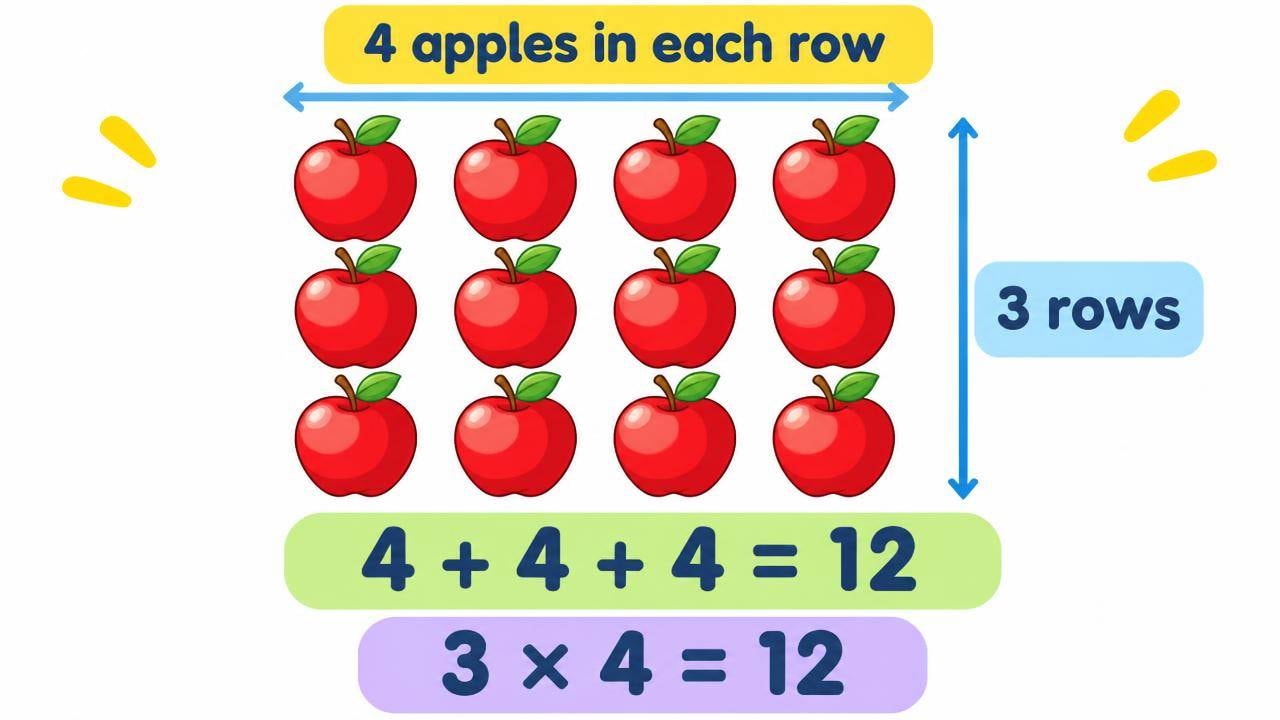
Imagine apples arranged like this:
● ● ● ●
● ● ● ●
● ● ● ●
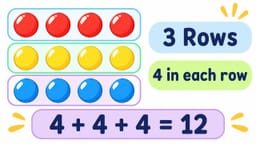
- There are 3 rows.
- There are 4 apples in each row.
- There are also 4 columns, with 3 apples in each column.
How many apples are there altogether? You could count each apple, but the equal rows give you other ways to find the total.
From Counting to Adding Equal Groups
Each row in the apple array is a group of 4. Because there are 3 equal rows, we can add 4 three times:
4 + 4 + 4 = 12
Adding the same number again and again is called repeated addition. An array makes the equal groups easy to see.
Try Skip Counting
We can also count by 4s, saying one number for each row:
4, 8, 12
The last number tells us the total. There are 12 apples altogether.
How Does an Array Show Multiplication?
Multiplication is a way to find the total in equal groups. Instead of writing 4 + 4 + 4, we can write:
3 × 4 = 12
The symbol × means times. In this example, we read the equation as “3 times 4 equals 12.” It describes 3 groups of 4.
- 3 tells us the number of rows.
- 4 tells us how many objects are in each row.
- 12 tells us how many objects there are altogether.
For the arrays in this lesson: number of rows × number in each row = total number of objects.
Build an Array Step by Step
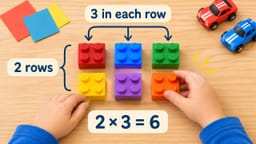
Use counters, blocks, or paper squares to build an array with 2 rows of 5.
- Place 5 objects in a straight row.
- Make another row of 5 directly underneath.
- Line up the objects so that the columns are easy to see.
- Check that both rows have the same number of objects.
- Add the rows: 5 + 5 = 10.
- Write the multiplication equation: 2 × 5 = 10.
You have made 2 equal groups of 5. There are 10 objects altogether!
What Happens When We Turn an Array?
Look again at 3 rows of 4 apples. If you turn the array so that its rows become columns, you will see 4 rows of 3.
- Before turning: 3 × 4 = 12.
- After turning: 4 × 3 = 12.
The objects have not changed, and none have been added or taken away. The total is still 12. Arrays help us see that swapping the order of the two numbers in a multiplication equation gives the same total.
Find Arrays in Everyday Life
Once you know what to look for, you can spot arrays in many places:
- A baking tray with 2 rows of 3 muffins: 2 × 3 = 6.
- A sticker sheet with 3 rows of 5 stickers: 3 × 5 = 15.
- A group of chairs with 4 rows of 2 chairs: 4 × 2 = 8.
Check each arrangement carefully. Are the rows equal? Do the objects line up in columns? If so, you have found an array!
Check Your Understanding
1. Count the Buttons
There are 3 rows of buttons with 2 buttons in each row. What repeated addition and multiplication equations describe the array?
Answer: 2 + 2 + 2 = 6 and 3 × 2 = 6. There are 6 buttons.
2. Make an Array of 8
Arrange 8 counters in 2 equal rows. How many counters belong in each row?
Answer: Each row has 4 counters, so 2 × 4 = 8. Can you turn your array to show 4 × 2 = 8?
3. Is It an Array?
One row has 3 blocks, and the row beneath it has 4 blocks. Do these blocks form an array?
Answer: Not yet! The rows are not equal. Add 1 block to the shorter row to make 2 rows of 4, or remove 1 block from the longer row to make 2 rows of 3.
Key Takeaways
- An array has equal rows and columns.
- Rows go across, and columns go up and down.
- Arrays show equal groups that we can count, add, or multiply.
- Multiplying the number of rows by the number in each row gives the total.
- Turning an array changes how we see its rows and columns, but not its total.
Try making an array with a few small objects today. Count the rows, count the objects in each row, and say the multiplication equation. You are turning equal groups into multiplication!