At the heart of calculus lie two fundamental operations: integration and differentiation. While integration measures accumulation, differentiation measures the rate at which things change. But before we can calculate how fast a function is changing at any given instant, we must ask a foundational question: Is it even possible to calculate this rate of change? This brings us to the core mathematical concept of differentiability.
Differentiability is more than just a technical prerequisite for finding a derivative; it is a profound structural property of functions that bridges geometry, algebra, and real-world physics. In this comprehensive guide, we will explore what differentiability means, define it rigorously using limits, investigate its geometric implications, analyze why it differs from continuity, and prove how the rules of differentiation are built from the ground up.
The Fundamental Definition: What Does It Mean to Be Differentiable?
At its simplest, a function is differentiable at a specific point if it has a well-defined derivative at that point. In physical terms, this means the function has a unique, unambiguous rate of change at that exact instant. If a function is differentiable at every point in its domain, we call it a differentiable function.
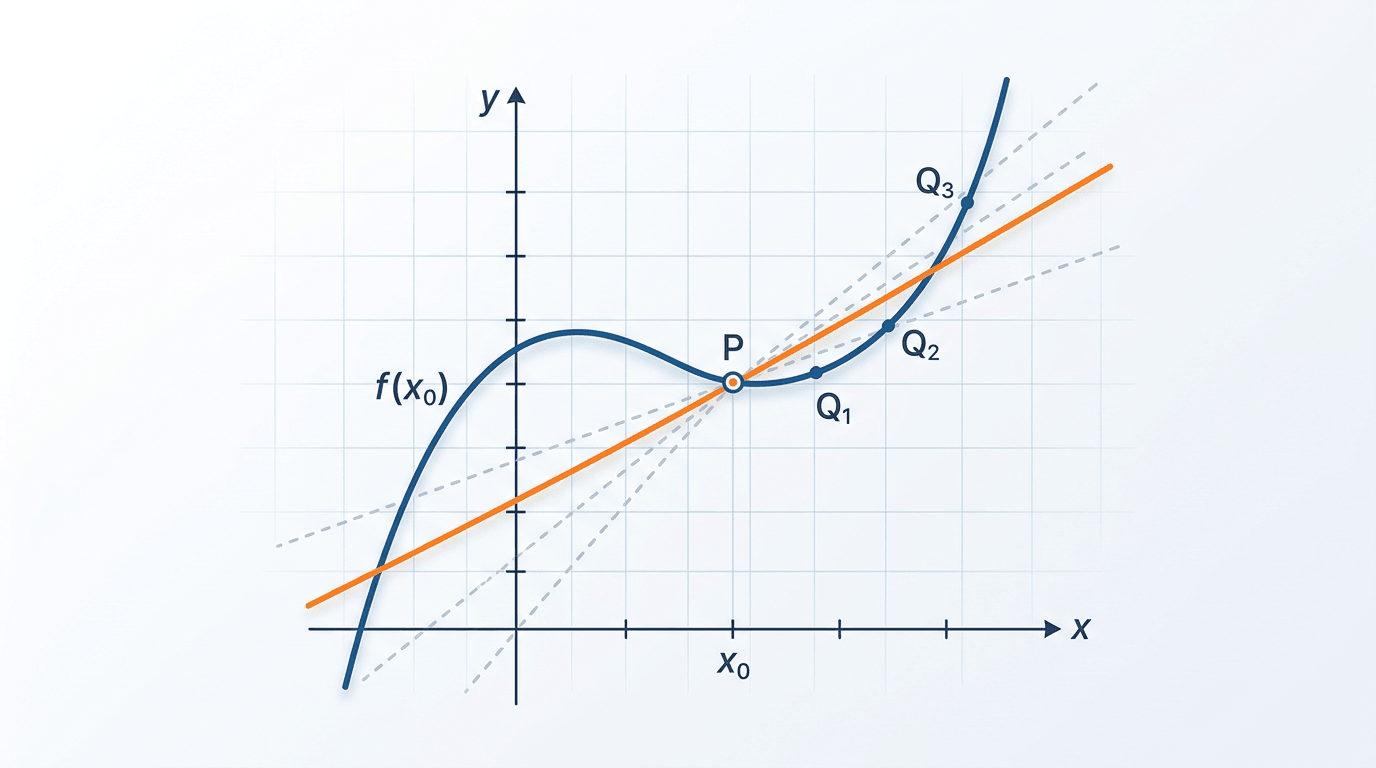
To understand this mathematically, we must look at the limit definition of the derivative. Let f be a real-valued function defined on an open interval containing the point x. The derivative of f at x, denoted by f'(x), is defined as:
f'(x) = lim (h → 0) [f(x + h) - f(x)] / h
For the function to be differentiable at x, this limit must exist and be a finite real number. If the limit does not exist, or if it approaches infinity, then the function is not differentiable at that point.
Alternatively, we can express this limit by looking at a specific point a. Let x approach a. The derivative of f at a is:
f'(a) = lim (x → a) [f(x) - f(a)] / (x - a)
For this limit to exist, the one-sided limits from the left and the right must both exist and be equal to each other. That is:
lim (x → a−) [f(x) - f(a)] / (x - a) = lim (x → a+) [f(x) - f(a)] / (x - a)
If these left-hand and right-hand derivatives do not match, the limit does not exist, and the function is not differentiable at a.
The Geometric Interpretation: Smoothness and Local Linearity
Geometrically, the derivative represents the slope of the tangent line to the graph of the function at a given point. Therefore, saying a function is differentiable at a point means that we can draw a single, unique tangent line to the curve at that point.
This leads to the concept of local linearity. If you take a differentiable curve and zoom in closer and closer to a single point, the curve begins to look like a straight line. The slope of this straight line is the derivative. If a function is differentiable, it is "locally linear."
When Does Differentiability Fail?
To truly understand differentiability, it is helpful to look at cases where it fails. A function will fail to be differentiable at a point under several distinct geometric conditions:
Sharp Corners or Knuckles (Cusps): Consider the absolute value function, f(x) = |x|. At x = 0, the graph makes a sharp "V" shape. If you approach x = 0 from the left, the slope is constantly -1. If you approach from the right, the slope is constantly +1. Because the left-hand and right-hand limits of the difference quotient do not agree, the derivative does not exist at x = 0. The graph is continuous there, but not differentiable.
Discontinuities: If a graph has a break, a hole, or a vertical asymptote at a point, you cannot draw a tangent line. A function cannot be differentiable at any point where it is discontinuous.
Vertical Tangents: Consider the cube root function, f(x) = x^(1/3). As x approaches 0, the tangent line becomes steeper and steeper, eventually becoming perfectly vertical at x = 0. A vertical line has an undefined (infinite) slope. Because the limit of the difference quotient goes to infinity, the function is not differentiable at x = 0.
The Relationship Between Differentiability and Continuity
One of the most important theorems in real analysis is the relationship between differentiability and continuity. The theorem states:
Theorem: If a function f is differentiable at a point x = a, then f must also be continuous at x = a.
The proof of this theorem is elegant and direct. We want to show that the limit of f(x) as x approaches a is equal to f(a), which is the definition of continuity. We can write the difference f(x) - f(a) as:
f(x) - f(a) = [ (f(x) - f(a)) / (x - a) ] * (x - a)
Now, we take the limit of both sides as x approaches a:
lim (x → a) [f(x) - f(a)] = lim (x → a) [ [ (f(x) - f(a)) / (x - a) ] * (x - a) ]
Using the limit product rule, we can split this into two limits:
lim (x → a) [f(x) - f(a)] = [ lim (x → a) (f(x) - f(a)) / (x - a) ] * [ lim (x → a) (x - a) ]
Since the function is differentiable at a, the first limit is the finite number f'(a). The second limit is simply 0. Therefore:
lim (x → a) [f(x) - f(a)] = f'(a) * 0 = 0
This implies that lim (x → a) f(x) = f(a), proving that f is continuous at a.
The Converse is NOT True
While differentiability guarantees continuity, continuity does not guarantee differentiability. The absolute value function f(x) = |x| is continuous everywhere (you can draw its entire graph without lifting your pencil), but it is not differentiable at x = 0. This distinction is crucial for students of mathematics to internalize.
Proving Differentiation Rules via the Limit Definition
To build a rigorous framework for calculus, we must prove that the algebraic operations we perform on differentiable functions also yield differentiable functions. Let us derive the fundamental rules of differentiation using the limit definition of the derivative.
1. The Sum and Difference Rules
Let f and g be differentiable functions at x. Let S(x) = f(x) + g(x). We want to find S'(x):
S'(x) = lim (h → 0) [S(x + h) - S(x)] / h
Substitute the definition of S(x):
S'(x) = lim (h → 0) [ (f(x + h) + g(x + h)) - (f(x) + g(x)) ] / h
Rearrange the terms:
S'(x) = lim (h → 0) [ (f(x + h) - f(x)) + (g(x + h) - g(x)) ] / h
Split the fraction and apply the sum rule for limits:
S'(x) = lim (h → 0) [f(x + h) - f(x)]/h + lim (h → 0) [g(x + h) - g(x)]/h
This yields:
S'(x) = f'(x) + g'(x)
The same logic applies to the difference rule, proving that the derivative of a sum or difference is the sum or difference of the derivatives.
2. The Product Rule
Let P(x) = f(x) * g(x), where both f and g are differentiable. The derivative is:
P'(x) = lim (h → 0) [f(x + h)g(x + h) - f(x)g(x)] / h
To evaluate this, we use a classic mathematical technique: adding and subtracting the same term, f(x + h)g(x), in the numerator:
P'(x) = lim (h → 0) [f(x + h)g(x + h) - f(x + h)g(x) + f(x + h)g(x) - f(x)g(x)] / h
Group and factor the terms:
P'(x) = lim (h → 0) [ f(x + h) * (g(x + h) - g(x)) + g(x) * (f(x + h) - f(x)) ] / h
Distribute the limit:
P'(x) = [ lim (h → 0) f(x + h) ] * [ lim (h → 0) (g(x + h) - g(x))/h ] + g(x) * [ lim (h → 0) (f(x + h) - f(x))/h ]
Since f is differentiable, it is continuous, meaning lim (h → 0) f(x + h) = f(x). Thus, we obtain the Product Rule:
P'(x) = f(x)g'(x) + g(x)f'(x)
3. The Quotient Rule
Let Q(x) = f(x) / g(x), where g(x) ≠ 0. The limit definition gives:
Q'(x) = lim (h → 0) [ (f(x + h)/g(x + h)) - (f(x)/g(x)) ] / h
Find a common denominator for the numerator:
Q'(x) = lim (h → 0) [ (f(x + h)g(x) - f(x)g(x + h)) / (g(x + h)g(x)) ] / h
Bring the h into the denominator and add/subtract f(x)g(x) in the numerator:
Q'(x) = lim (h → 0) [ f(x + h)g(x) - f(x)g(x) + f(x)g(x) - f(x)g(x + h) ] / [ h * g(x + h)g(x) ]
Factor the numerator terms:
Q'(x) = lim (h → 0) [ g(x) * (f(x + h) - f(x)) - f(x) * (g(x + h) - g(x)) ] / [ h * g(x + h)g(x) ]
Separate the fractions and take the limit as h → 0:
Q'(x) = [ g(x)f'(x) - f(x)g'(x) ] / [ g(x) ]^2
4. The Chain Rule (Composite Functions)
For composite functions, y = f(g(x)), the derivative is found via the Chain Rule. If g is differentiable at x and f is differentiable at g(x), then the composite function is differentiable, and its derivative is:
(f ˆ g)'(x) = f'(g(x)) * g'(x)
This rule represents how changes cascade through nested systems: the rate of change of the outer function with respect to the inner function, multiplied by the rate of change of the inner function with respect to the independent variable.
Evaluating the Utility of Differentiability Proofs
Why do mathematicians spend so much effort proving these rules from first principles? Why not just memorize the shortcuts?
The utility of these proofs lies in their guarantee of mathematical consistency. By proving these rules once using limits, we establish a robust framework. We no longer need to perform tedious limit calculations for every new function we encounter. Instead, we can confidently decompose complex equations into smaller parts, knowing that differentiability is preserved through algebraic operations. This allows us to scale mathematical models to handle highly complex systems in engineering, physics, and economics.
Differentiability in the Physical and Scientific World
Differentiability is not just an abstract mathematical game; it is a fundamental property of the physical universe as described by science. Nature, at a macroscopic level, is smooth and continuous.
Physics (Kinematics): The position of a moving car must be a differentiable function of time. If position were not differentiable, the velocity (the derivative of position) would not exist at that moment, implying the car instantly changed its speed without accelerating—a physical impossibility.
Chemistry (Reaction Kinetics): The concentration of reactants over time must be differentiable so that scientists can calculate the instantaneous rate of reaction at any given point during a chemical process.
Economics (Marginal Analysis): Cost and revenue functions are assumed to be differentiable so that businesses can compute marginal cost and marginal revenue to find the exact production level that maximizes profit.
Conclusion and Key Takeaways
Differentiability is the gatekeeper of calculus. Understanding it allows us to analyze dynamic systems with absolute precision. Here are the most critical points to remember:
Definition: A function is differentiable at a point if the limit of its difference quotient exists and is finite.
Continuity: Differentiability implies continuity, but continuity does not guarantee differentiability (e.g., sharp corners like |x|).
Geometry: Differentiable curves are smooth and locally linear, meaning they can be approximated by a unique straight tangent line when zoomed in.
Algebraic Preservation: The sum, difference, product, quotient, and composition of differentiable functions remain differentiable, and their derivatives can be systematically calculated using proven rules.
By mastering the concept of differentiability, you unlock the ability to model, understand, and predict the continuous changes that shape our physical world.