In mathematics, particularly in calculus and mathematical analysis, the concept of continuity is one of the most fundamental pillars. When we visualize a function on a graph, we often intuitively think of a continuous function as one that we can draw from left to right without lifting our pencil from the paper. But what happens when we must lift our pencil? What happens when there is a sudden break, a hole, or an infinite leap in the graph?
This brings us to the study of discontinuous functions. A discontinuous function is, in simple terms, a function that is not continuous at one or more points in its domain. Understanding these mathematical anomalies is not just an academic exercise; it is essential for modeling real-world phenomena, from quantum physics to manufacturing costs. In this comprehensive guide, we will explore the precise definition of discontinuity, examine its various types, learn how to identify them mathematically, and see how they apply to real-world scenarios.
The Mathematical Definition of Continuity
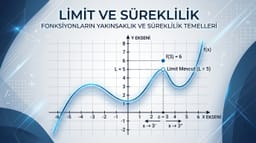
To fully understand what makes a function discontinuous, we must first establish the rigorous mathematical definition of a continuous function. A function f(x) is said to be continuous at a specific point x = c if and only if it satisfies three strict conditions:
The function must be defined at that point: The value f(c) must exist. In other words, c must be in the domain of f(x).
The limit of the function must exist as x approaches c: The limit of f(x) as x approaches c from both the left and the right must exist and be equal. Mathematically, limx → c f(x) = L.
The limit and the function value must be equal: The value that the function approaches must be exactly equal to the value of the function at that point. Mathematically, limx → c f(x) = f(c).
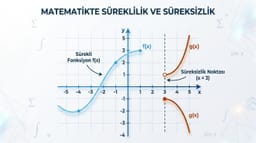
The Continuity Principle: If any one of these three conditions fails to hold at a point x = c, then the function f(x) is said to be discontinuous at x = c, and the point c is called a point of discontinuity.
Types of Discontinuity
Not all discontinuities are created equal. Mathematicians classify discontinuities into distinct categories based on which of the three continuity conditions fail. Understanding these classifications helps us analyze the behavior of functions near their critical points.
1. Removable Discontinuity (Hole)
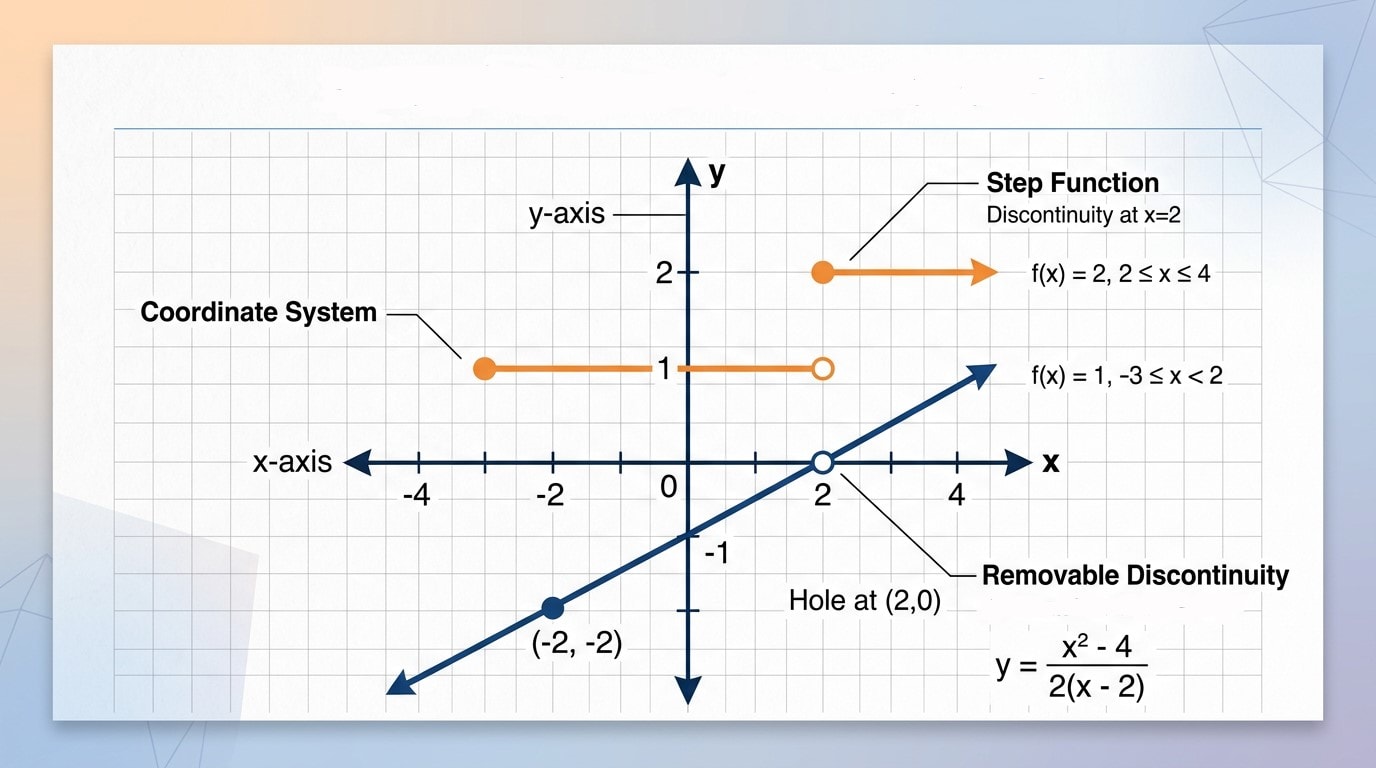
A removable discontinuity occurs when the limit of the function exists as x approaches c, but either the function is not defined at c, or the value of the function at c is different from the limit.
It is called "removable" because we could easily "fill" the hole by redefining the function at that single point to match the limit.
Mathematical Example: Consider the function:
f(x) = (x2 - 4) / (x - 2)
If we try to evaluate this function at x = 2, we get 0/0, which is undefined. Thus, f(2) does not exist, violating the first condition of continuity. However, if we simplify the function for all x ≠ 2:
f(x) = ((x - 2)(x + 2)) / (x - 2) = x + 2
As x approaches 2, the limit is:
limx → 2 f(x) = 2 + 2 = 4
Because the limit exists (it equals 4) but the function is undefined at x = 2, there is a removable discontinuity (a hole) at x = 2.
2. Jump Discontinuity
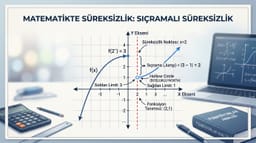
A jump discontinuity occurs when the one-sided limits of the function as x approaches c both exist as finite numbers, but they are not equal to each other. This causes the graph of the function to "jump" from one value to another at x = c.
Because the left-hand limit and the right-hand limit do not agree, the overall limit limx → c f(x) does not exist.
Mathematical Example: Consider the piecewise function:
g(x) = x + 1 for x < 1
g(x) = x2 + 3 for x ≥ 1
Let us analyze the behavior of this function as x approaches 1:
Left-hand limit: limx → 1- g(x) = 1 + 1 = 2
Right-hand limit: limx → 1+ g(x) = 12 + 3 = 4
Since the left-hand limit (2) does not equal the right-hand limit (4), the limit of g(x) as x approaches 1 does not exist. Therefore, g(x) has a jump discontinuity at x = 1.
3. Infinite / Essential Discontinuity
An infinite discontinuity (often called an essential discontinuity) occurs when one or both of the one-sided limits as x approaches c go to positive or negative infinity. This typically manifests on a graph as a vertical asymptote.
Mathematical Example: Consider the rational function:
h(x) = 1 / x2
As x approaches 0 from either the left or the right, the values of h(x) grow without bound:
limx → 0 (1 / x2) = ∞
Because the limit approaches infinity, the function is discontinuous at x = 0, representing an infinite discontinuity.
4. Oscillating Discontinuity
An oscillating discontinuity occurs when a function oscillates infinitely many times between different values as it approaches a point, preventing a single limit from being established.
Mathematical Example: The function f(x) = sin(1/x) as x approaches 0. As x gets closer and closer to 0, the term 1/x approaches infinity, causing the sine function to swing wildly and infinitely fast between -1 and 1. Because the function never settles down to a single value, the limit does not exist at x = 0.
Analyzing Critical Points in Piecewise Functions
Piecewise functions are the primary domain where students encounter and analyze discontinuities. To evaluate whether a piecewise function is continuous or discontinuous, we must focus our attention on the critical points (the boundary values where the function changes its formula).
Let's perform a step-by-step continuity analysis on the following piecewise function at its critical point x = 3:
f(x) = 2x + k for x ≤ 3
f(x) = x2 - 1 for x > 3
We want to determine the value of the constant k that would make the function continuous at x = 3. If k is any other value, the function will be discontinuous.
Step 1: Find the value of the function at x = 3.
Using the first part of the piecewise definition (since it includes x ≤ 3):
f(3) = 2(3) + k = 6 + k
Step 2: Find the left-hand limit as x approaches 3.
limx → 3- f(x) = limx → 3- (2x + k) = 6 + k
Step 3: Find the right-hand limit as x approaches 3.
limx → 3+ f(x) = limx → 3+ (x2 - 1) = 32 - 1 = 8
Step 4: Set the left-hand and right-hand limits equal to find k.
For the overall limit to exist and for the function to be continuous, we need:
6 + k = 8
k = 2
If k = 2, the function is continuous. If k ≠ 2, the function has a jump discontinuity at x = 3 because the left-hand limit and right-hand limit will not align.
Real-World Applications of Discontinuous Functions
While continuous functions are wonderful for modeling smooth, uninterrupted physical processes (like the path of a thrown ball), many real-world systems are inherently discrete, step-like, or subject to sudden changes. These are modeled using discontinuous functions.
1. Production Costs and Bulk Pricing
In economics and industrial manufacturing, the cost of producing or purchasing goods often changes abruptly based on quantity. This is known as bulk pricing or step-rate pricing.
Imagine a manufacturing plant where the setup cost for a production run is 2 to produce. However, if you order more than 1,000 units, the factory switches to a high-efficiency assembly line, reducing the unit cost to $1.50 but requiring a setup fee adjustment. The total cost function C(x) as a function of quantity x will feature a sharp jump discontinuity at x = 1000.
2. Utility Tariffs and Tax Brackets
Electricity, water, and postal services often charge using step functions (like the Greatest Integer Function). For example, mailing a letter might cost 0.84. This creates a series of jump discontinuities at every integer ounce boundary.
3. Quantum Mechanics and State Transitions
In physics, quantum mechanics is built on the idea that energy is not continuous but exists in discrete packets called "quanta." When an electron in an atom absorbs energy, it transitions from one energy level to another. It does not travel through the space between levels; it instantly disappears from one level and appears in another. This quantum leap is a physical manifestation of a discontinuous step function.
Key Takeaways
A function is continuous at a point if it is defined at that point, its limit exists at that point, and the limit matches the function's value.
If any of these three criteria are violated, the function has a discontinuity.
The main types of discontinuities are removable (holes), jump (abrupt shifts in value), infinite (asymptotes), and oscillating.
Piecewise functions are analyzed at their critical boundary points by comparing left-hand and right-hand limits.
Discontinuous functions are essential for modeling real-world phenomena such as economic pricing steps, digital signals, and quantum state changes.