While differentiation follows strict, systematic rules—such as the product rule, quotient rule, and chain rule—finding the antiderivative of a complex function can feel like trying to untangle a knotted rope. Fortunately, mathematicians developed a powerful technique designed specifically to reverse one of the most common differentiation processes: the chain rule. This technique is known as the Substitution Rule, or more colloquially, u-substitution.
Whether you are a physics student calculating the work done by a variable force, a chemistry student modeling reaction kinetics, or a mathematics enthusiast diving deep into real analysis, mastering the substitution rule is essential. This comprehensive guide will explore the mathematical foundations of the substitution rule, provide step-by-step methodologies for both indefinite and definite integrals, examine real-world scientific applications, and address common pitfalls to ensure you can apply this tool with absolute confidence.
The Conceptual Foundation: Reversing the Chain Rule
To truly understand why the substitution rule works, we must first look backward at differentiation. Recall the Chain Rule, which is used to differentiate composite functions. If you have a composite function F(g(x)), its derivative with respect to x is given by:
d/dx [F(g(x))] = F'(g(x)) · g'(x)
Now, let us apply the Fundamental Theorem of Calculus, which states that integration is the reverse process of differentiation. If we integrate both sides of the equation above with respect to x, we get:
∫ F'(g(x)) · g'(x) dx = F(g(x)) + C
If we define a new function f such that f(x) = F'(x), then the equation becomes:
∫ f(g(x)) · g'(x) dx = F(g(x)) + C
This is the formal mathematical statement of the Substitution Rule. It allows us to simplify a highly complex integral by introducing a new variable, typically named u, to stand in for the inner function g(x). By changing the variable of integration from x to u, we transform a daunting expression into a standard, easily solvable integral.
The Formal Definition of the Substitution Rule
Let g be a differentiable function whose range is an interval I, and let f be a function that is continuous on I. If u = g(x), then:
∫ f(g(x)) g'(x) dx = ∫ f(u) du
In this formulation, the term g'(x) dx is replaced entirely by du. This is not merely a symbolic shorthand; it is rooted in the definition of differentials. When we write u = g(x), the differential of u is defined as:
du = g'(x) dx
This clean substitution collapses a complicated product of functions into a single, elegant expression that can be integrated using basic integration formulas.
Step-by-Step Methodology for Indefinite Integrals
Applying the substitution rule successfully requires pattern recognition and a structured approach. Here is the step-by-step process to solve any indefinite integral using u-substitution:
Identify the Inner Function: Look for a composite function within the integrand. Identify a part of the integrand, g(x), whose derivative g'(x) (or a constant multiple of it) is also present in the integrand. Set u = g(x).
Calculate the Differential: Compute the derivative of u with respect to x to find du = g'(x) dx.
Substitute: Replace all instances of g(x) with u, and replace g'(x) dx with du. The resulting integral must be entirely in terms of u, with no remaining x variables.
Integrate: Evaluate the simplified integral with respect to u.
Back-Substitute: Replace u with the original function g(x) so that your final answer is expressed in terms of the original variable x. Don't forget to add the constant of integration, + C.
Detailed Examples of Indefinite Integration
Let us walk through three distinct examples to see this methodology in action across different types of functions.
Example 1: A Polynomial and Power Function
Evaluate the following integral:
∫ 2x (x2 + 5)4 dx
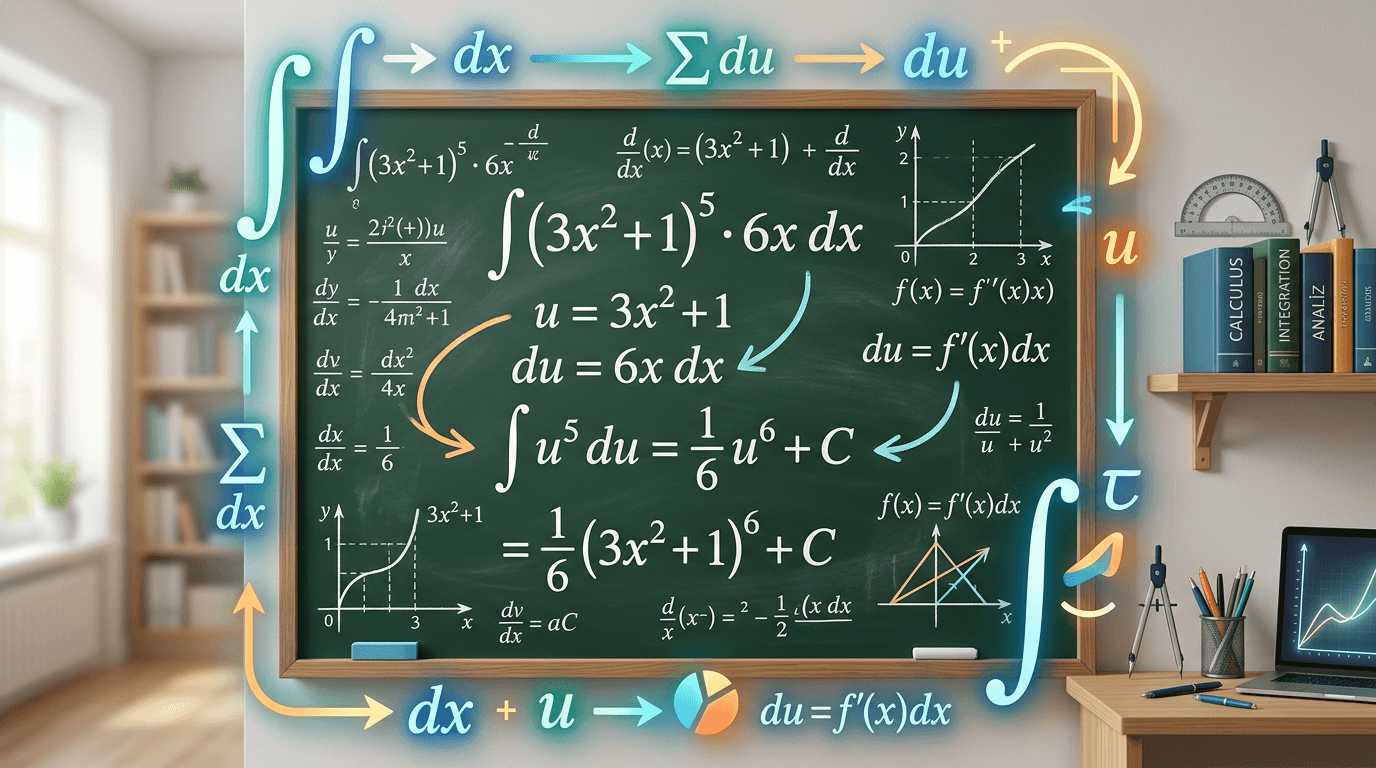
Step 1: Identify the inner function. We see a composite function where (x2 + 5) is raised to the power of 4. Let's choose this as our inner function:
u = x2 + 5
Step 2: Calculate the differential. Differentiating u gives:
du = 2x dx
Step 3: Substitute. Notice that 2x dx is perfectly present in our original integral. Substituting these terms yields:
∫ u4 du
Step 4: Integrate. Using the power rule for integration:
∫ u4 du = (u5 / 5) + C
Step 5: Back-substitute. Replace u with x2 + 5:
Answer: (x2 + 5)5 / 5 + C
Example 2: Trigonometric Functions with Constants
Evaluate the following integral:
∫ x2 cos(x3) dx
Step 1: Identify the inner function. The angle of the cosine function is x3. Let's set:
u = x3
Step 2: Calculate the differential.
du = 3x2 dx
Step 3: Substitute. Our integral contains x2 dx, but not the coefficient 3. We can manipulate our differential equation to match:
(1/3) du = x2 dx
Now substitute this into the integral:
∫ cos(u) · (1/3) du = 1/3 ∫ cos(u) du
Step 4: Integrate. The antiderivative of cosine is sine:
1/3 sin(u) + C
Step 5: Back-substitute. Replace u with x3:
Answer: 1/3 sin(x3) + C
The Substitution Rule for Definite Integrals
When evaluating definite integrals (integrals with upper and lower limits), we have a choice: we can either find the indefinite integral first, back-substitute, and apply the limits; or we can transform the limits of integration at the same time we substitute the variables. The latter method is highly preferred because it is mathematically elegant and reduces algebraic errors.
The formal rule for definite integrals is stated as:
∫ab f(g(x)) g'(x) dx = ∫g(a)g(b) f(u) du
By changing the limits from x = a and x = b to u = g(a) and u = g(b), we completely eliminate the need to back-substitute at the end of the problem. We simply evaluate the new integral using the new limits.
Example 3: Definite Integration with Limit Transformation
Evaluate the following definite integral:
∫01 x (x2 + 1)3 dx
Let u = x2 + 1. Then, du = 2x dx, which means (1/2) du = x dx.
Now, let us transform the limits of integration:
When the lower limit is x = 0: u = (0)2 + 1 = 1
When the upper limit is x = 1: u = (1)2 + 1 = 2
Substitute these values into the definite integral:
∫12 u3 · (1/2) du = 1/2 ∫12 u3 du
Now, integrate directly with respect to u:
1/2 [ u4 / 4 ]12 = 1/8 [ u4 ]12
Evaluate at the new boundaries:
1/8 (24 - 14) = 1/8 (16 - 1) = 15/8
Answer: 15/8
Scientific and Physical Applications
The substitution rule is not merely an academic exercise; it is an indispensable tool in physics, chemistry, and engineering. Many physical laws are formulated as differential equations or integrals that cannot be solved without changing variables.
1. Work Done by a Variable Force
In physics, work (W) is defined as the integral of force (F) over a displacement path:
W = ∫ F(x) dx
If the force is dependent on a changing physical state—such as the compression of a non-linear spring or the gravitational pull between two moving planets—the force function can be highly complex. For instance, if the force is given by F(x) = kx / (1 + x2)2, finding the work done requires setting u = 1 + x2, turning a difficult physics problem into a simple logarithmic or power-rule integration.
2. Chemical Reaction Kinetics
In physical chemistry, reaction rates describe how fast reactants turn into products. For a second-order reaction, the integrated rate law is derived by integrating an expression of the form:
∫ [1 / (a - x)2] dx
By substituting u = a - x (where du = -dx), chemists can easily integrate the rate equation to determine how reactant concentrations change over time, allowing for the precise design of chemical reactors and pharmaceutical shelf-lives.
Common Pitfalls and How to Avoid Them
Even experienced students can make mistakes when applying the substitution rule. Keep these common traps in mind to avoid errors:
Forgetting the Differential (dx): Treating dx as a decorative symbol at the end of an integral is a critical mistake. The differential is a mathematical quantity. You must calculate du and solve for dx or its equivalent expression to substitute correctly.
Mixing Variables: Never leave an integral with both x and u variables under the same integration sign (e.g., ∫ x u2 du). If you cannot eliminate all instances of x, you may have chosen the wrong u, or the integral may require a different technique altogether.
Neglecting to Change Limits: In definite integrals, if you write the original x-limits on your u-integral, you will get the wrong answer unless you back-substitute. It is always safer and cleaner to convert your limits immediately.
Key Takeaways
The Substitution Rule is the integration equivalent of reversing the differentiation Chain Rule.
The core goal is to simplify a complex integrand by changing the variable of integration from x to u.
For indefinite integrals, always remember to back-substitute the original function at the end and add the constant of integration + C.
For definite integrals, transforming the integration limits to match u simplifies the process and avoids the need for back-substitution.