


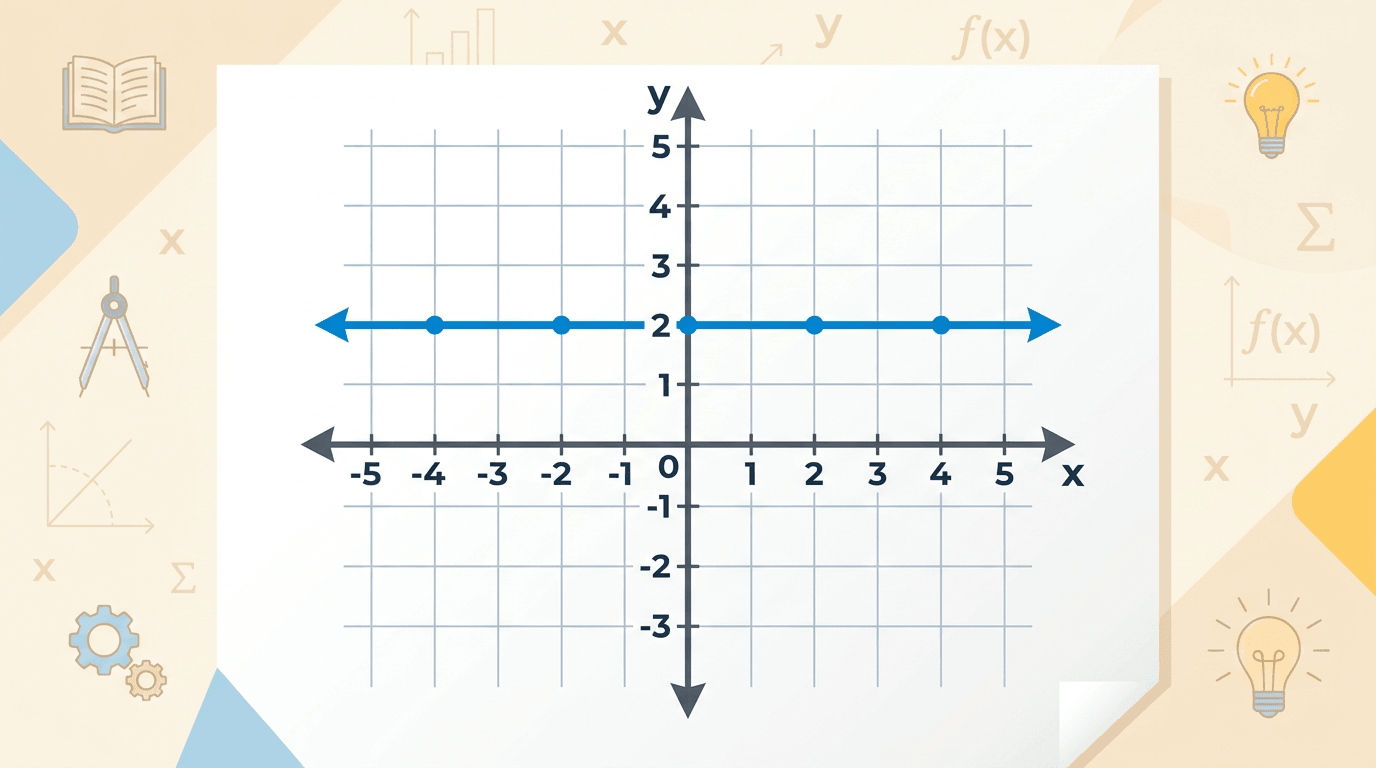
The derivative measures how a function changes as its input changes—essentially representing the instantaneous rate of change or the slope of the curve at any given point. But what happens when we look at a function that does not change at all? What is the derivative of a constant function?
The short and absolute answer is: the derivative of any constant function is always zero. Whether the constant is 5, -100, pi, or one million, its rate of change is non-existent because its value remains perfectly still. In this comprehensive guide, we will explore this fundamental rule of calculus from multiple perspectives, including geometric intuition, rigorous mathematical proofs, and real-world physical analogies.
Understanding Constant Functions
Before diving into the calculus of constant functions, it is essential to clarify what a constant function is. In algebra, a function is a rule that assigns an output to each input. A constant function is a special type of function where the output is always the same, regardless of the input value.
Mathematically, we write a constant function as:
f(x) = c
where c is a fixed real number. No matter what value you substitute for x—whether it is 1, 10, or -500—the output f(x) will always be c. For example, if f(x) = 5, then:
f(1) = 5
f(10) = 5
f(-3.14) = 5
If you plot a constant function on a two-dimensional Cartesian coordinate system, where the horizontal axis represents x and the vertical axis represents y, the graph of y = c is a perfectly horizontal line. This line lies parallel to the x-axis and intersects the y-axis at the point (0, c).
What is a Derivative?
To understand why the derivative of a constant function is zero, we must revisit the definition of a derivative. In calculus, the derivative of a function f(x) at a point x, denoted as f'(x) or df/dx, represents the instantaneous rate of change of the function with respect to x.
There are three primary ways to visualize and understand a derivative:
Geometric Interpretation: The derivative represents the slope of the tangent line to the graph of the function at any given point.
Physical Interpretation: The derivative represents velocity or the rate of change. If f(x) represents position over time, then the derivative represents speed.
Algebraic Interpretation: The derivative is the limit of the average rate of change as the interval of change approaches zero.
The Core Explanation: Why the Derivative is Zero
Let us apply these three interpretations directly to a constant function f(x) = c:
The Geometric Explanation: Since the graph of a constant function is a straight horizontal line, let us look at its slope. By definition, a horizontal line has no rise; it only has run. The formula for the slope (m) of a line passing through two points (x1, y1) and (x2, y2) is:
m = (y2 - y1) / (x2 - x1)
For a constant function, the y-value is always c. Therefore, y1 = c and y2 = c. Substituting these into the formula gives:
m = (c - c) / (x2 - x1) = 0 / (x2 - x1) = 0
Because the slope of a horizontal line is 0 everywhere, the tangent line at any point along this line is the line itself, which has a slope of 0. Thus, the derivative must be 0.
Rigorous Mathematical Proofs
While geometric intuition is helpful, mathematics requires rigorous proof. Let's look at the two main ways to prove that the derivative of a constant function is zero.
Proof 1: Using the Limit Definition of the Derivative
The formal definition of the derivative of a function f(x) is given by the limit of the difference quotient:
f'(x) = lim (as h approaches 0) [f(x + h) - f(x)] / h
Let us apply this definition to our constant function, f(x) = c:
First, identify f(x). Since it is a constant function, f(x) = c.
Next, identify f(x + h). Since the output of a constant function is always c, regardless of the input, f(x + h) is also equal to c.
Substitute these values into the limit formula: f'(x) = lim (as h approaches 0) [c - c] / h
Simplify the numerator: f'(x) = lim (as h approaches 0) 0 / h
Since h is approaching 0 but is not equal to 0, the fraction 0/h is exactly equal to 0. Therefore: f'(x) = lim (as h approaches 0) 0 = 0
This completes the proof. Using the fundamental definition of calculus, we have demonstrated that the derivative of any constant function is indeed zero.
Proof 2: Using the Power Rule
Another way to prove this is by using the Power Rule of differentiation. The Power Rule states that for any real number n:
d/dx [x^n] = n * x^(n - 1)
We can rewrite a constant function f(x) = c in terms of x by multiplying it by x^0 (since x^0 = 1 for all x not equal to 0):
f(x) = c * x^0
Now, let's apply the constant multiple rule and the power rule to differentiate this function:
f'(x) = d/dx [c * x^0] = c * d/dx [x^0]
Applying the Power Rule where n = 0:
f'(x) = c * (0 * x^(0 - 1)) = c * 0 = 0
Both proofs yield the exact same result: the derivative of a constant is always zero.
Physical and Scientific Interpretations
To solidify this concept, let us look at how this mathematical truth manifests in physical and scientific contexts.
1. Position and Velocity: Imagine a car parked on the side of a highway. Its position relative to a reference point does not change over time. If we write its position function as s(t) = 50 (meaning it is parked exactly 50 meters away), the derivative of position with respect to time is velocity, v(t) = ds/dt. Since the car is stationary, its velocity is 0. The derivative of the constant position function is zero because there is no motion.
2. Constant Temperature: Suppose a scientific incubator is set to maintain a constant temperature of 37 degrees Celsius. If we measure the temperature T(t) over time, the function is T(t) = 37. The rate of change of temperature over time (dT/dt) is 0 because the temperature is perfectly stable. If the temperature were changing, the derivative would be positive or negative, but for a constant state, it is zero.
3. Electrical Voltage: In a direct current (DC) circuit, the voltage supplied by a steady battery is constant over time, say V(t) = 9 volts. The rate of change of this voltage over time (dV/dt) is 0. This stability is crucial for the safe operation of electronic components.
Key Takeaways
Understanding the derivative of a constant function is a vital building block in calculus. Here is a summary of what we have covered:
The Rule: The derivative of any constant function is always zero: d/dx [c] = 0.
Geometric Meaning: The graph of a constant function is a horizontal line, which has a slope of zero.
Rate of Change: Constants do not change, so their rate of change is naturally zero.
Proofs: This rule is easily proven using either the formal limit definition of a derivative or the Power Rule.
Whether you are analyzing physical systems, economic models, or purely mathematical equations, remembering that constants have a derivative of zero will help you simplify complex derivatives and build a strong foundation for advanced calculus.