Imagine you are tracking a moving object. If you know its exact position at every moment, finding its velocity is a straightforward process of calculating its rate of change—a process known in calculus as differentiation. But what if you only know its velocity at any given moment and want to reconstruct its exact path? To solve this puzzle, you must work backward. You must reverse the process of differentiation. This reverse process is the foundation of integral calculus, and the mathematical tool we use to achieve it is called the indefinite integral.
The indefinite integral is one of the most powerful concepts in mathematics, acting as a bridge between rates of change and accumulated quantities. In this comprehensive guide, we will explore what an indefinite integral is, break down its mathematical notation, understand the mystery of the constant of integration, examine its fundamental rules, and look at how it is applied in physics and other sciences.
The Core Definition: What is an Indefinite Integral?
At its simplest level, an indefinite integral is an antiderivative. If you have a function f(x), its indefinite integral is another function F(x) whose derivative is equal to f(x). In other words, if:
F'(x) = f(x)
Then the indefinite integral of f(x) is F(x). While differentiation takes a function and finds its rate of change, integration takes a rate of change and reconstructs the original function.
The term "indefinite" is crucial here. Unlike a definite integral, which calculates a specific numerical value (such as the area under a curve between two specific points), an indefinite integral results in a family of functions. It does not have upper and lower limits of integration, meaning it represents a general state rather than a specific boundary-bounded value.
Anatomy of the Indefinite Integral Notation
To work with indefinite integrals, we must first understand the standard notation established by German mathematician Gottfried Wilhelm Leibniz. The mathematical expression is written as:
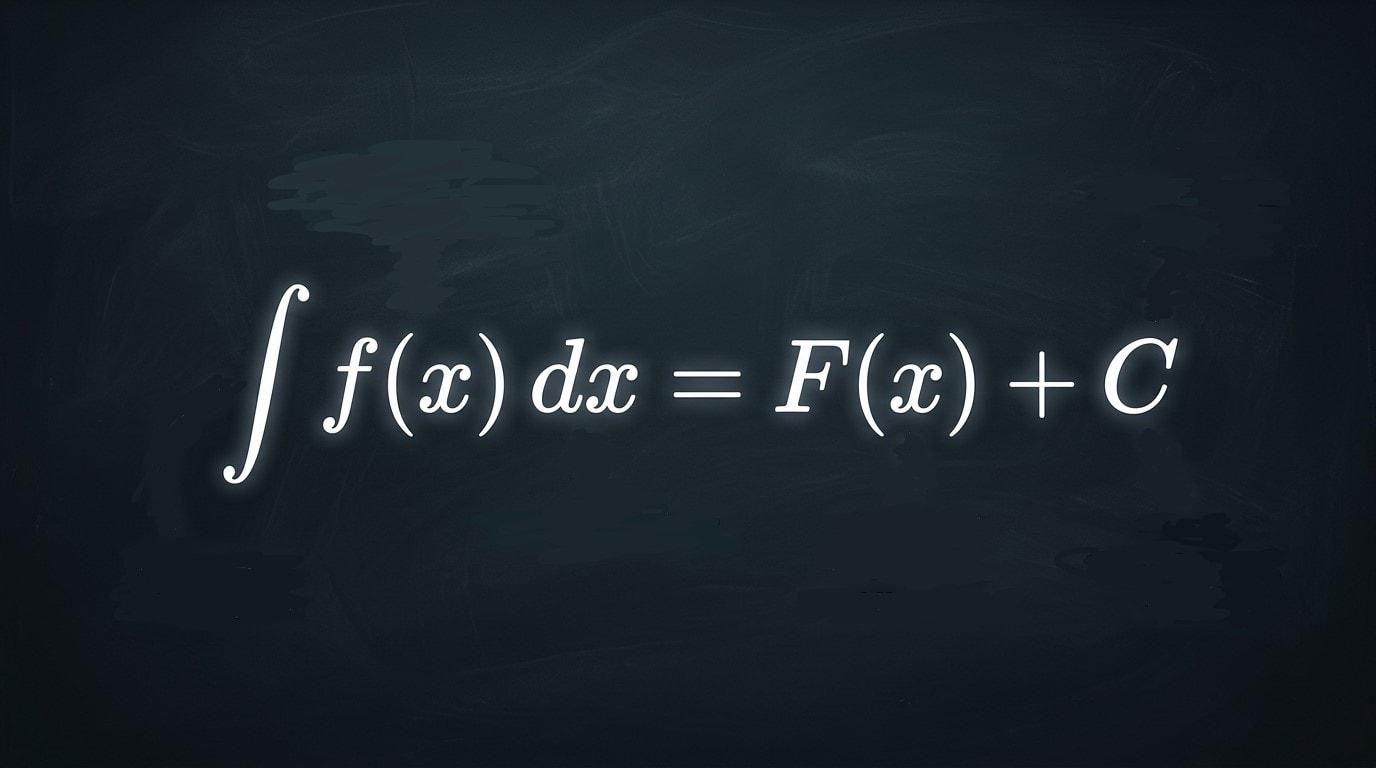
∫ f(x) dx = F(x) + C
Let's break down each component of this equation to understand its role:
∫ (The Integral Symbol): This elongated "S" stands for "summa" (Latin for sum). It represents the historical roots of integration as a process of infinite summation.
f(x) (The Integrand): This is the function that you want to integrate. It represents the rate of change or the derivative of the function you are trying to find.
dx (The Differential): This indicates the variable with respect to which you are integrating (in this case, x). It tells you which variable is the independent variable.
F(x) (The Antiderivative): This is the resulting function we obtain after performing the integration process.
C (The Constant of Integration): This is an arbitrary constant added to the end of every indefinite integral. It is a vital component that represents an infinite family of parallel curves.
The Mystery of the Constant of Integration (C)
Why do we always add "+ C" at the end of an indefinite integral? To understand this, we must look at how differentiation treats constants.
Consider the following three functions and their derivatives:
If y = x2 + 5, then dy/dx = 2x.
If y = x2 - 100, then dy/dx = 2x.
If y = x2, then dy/dx = 2x.
Notice that because the derivative of any constant is zero, all three of these distinct functions share the exact same derivative: 2x. Now, if we try to reverse this process and find the indefinite integral of 2x, we cannot know for certain which constant was in the original function. It could have been 5, -100, 0, or any other real number.
To account for this loss of information during differentiation, we write:
∫ 2x dx = x2 + C
Here, C represents any real number. Graphically, x2 + C represents a family of parabolas shifted vertically up or down along the y-axis. They all share the same slope (derivative) at any given value of x, but they start at different vertical positions.
Fundamental Rules of Indefinite Integration
Just as differentiation has specific rules (like the power rule and product rule), integration has its own set of fundamental rules derived directly from those inverse operations. Here are the most common rules every student must know:
1. The Power Rule for Integration
This rule reverses the power rule of differentiation. For any real number n not equal to -1:
∫ xn dx = (xn+1 / (n + 1)) + C
For example, to find the integral of x3, we add 1 to the exponent to get 4, and divide by this new exponent:
∫ x3 dx = (x4 / 4) + C
2. The Constant Multiple Rule
If you have a constant multiplier inside your integral, you can factor it outside the integral sign:
∫ k · f(x) dx = k · ∫ f(x) dx
3. The Sum and Difference Rule
The integral of a sum or difference of functions is the sum or difference of their individual integrals:
∫ (f(x) ± g(x)) dx = ∫ f(x) dx ± ∫ g(x) dx
4. Integration of Exponential Functions
Because the derivative of ex is ex, its integral is equally elegant:
∫ ex dx = ex + C
5. The Special Case of 1/x
The power rule fails when n = -1 because we cannot divide by zero. Instead, we use the natural logarithmic function:
∫ (1/x) dx = ln|x| + C
Scientific and Physical Applications
Kinematics: Reconstructing Motion
In physics, the relationships between position, velocity, and acceleration are defined by derivatives. Consequently, we use indefinite integrals to reverse these relationships:
Velocity from Acceleration: Since acceleration a(t) is the derivative of velocity v(t), we can find velocity by integrating acceleration: v(t) = ∫ a(t) dt.
Position from Velocity: Since velocity v(t) is the derivative of position s(t), we can find position by integrating velocity: s(t) = ∫ v(t) dt.
When we perform these integrations, the constant of integration C represents the initial conditions of the system, such as the initial velocity (v0) or the initial position (s0) of the object at time t = 0.
Thermodynamics and Work
In thermodynamics, physical work done by a gas during expansion can be modeled using integrals. When the pressure of a system changes dynamically as volume changes, the indefinite integral helps physicists derive general work equations before specific boundary pressures and volumes are applied.
Indefinite vs. Definite Integrals: A Quick Comparison
To fully grasp the nature of the indefinite integral, it helps to contrast it with its counterpart, the definite integral:
Feature Indefinite Integral Definite Integral Result Type A family of functions (contains + C) A specific real number Limits of Integration None Has lower and upper limits (a to b) Geometrical Meaning The general antiderivative curves The net area under a curve
Step-by-Step Solved Example
Let's apply these principles to solve a practical problem. Find the indefinite integral of the following polynomial function:
∫ (3x2 + 4x - 5) dx
Step 1: Use the Sum and Difference Rule to split the integral into three separate parts:
∫ 3x2 dx + ∫ 4x dx - ∫ 5 dx
Step 2: Factor out the constant coefficients:
3 · ∫ x2 dx + 4 · ∫ x dx - 5 · ∫ 1 dx
Step 3: Apply the Power Rule to each term:
For x2: (x3 / 3)
For x1: (x2 / 2)
For 1 (which is x0): x
Step 4: Combine the terms and add the constant of integration C:
3 · (x3 / 3) + 4 · (x2 / 2) - 5x + C
Step 5: Simplify the algebraic expression:
x3 + 2x2 - 5x + C
To double-check your work, you can differentiate the result. The derivative of x3 + 2x2 - 5x + C is indeed 3x2 + 4x - 5, proving our integration is correct!
Summary of Key Takeaways
An indefinite integral is the mathematical inverse of a derivative, representing the general antiderivative of a function.
The process of finding an indefinite integral yields a family of functions rather than a single numerical value.
The constant of integration (C) must always be added to represent the infinite possible vertical translations of the antiderivative curve.
In physical applications, solving an indefinite integral and using known starting values (initial conditions) allows us to find exact, specific formulas for real-world phenomena.