


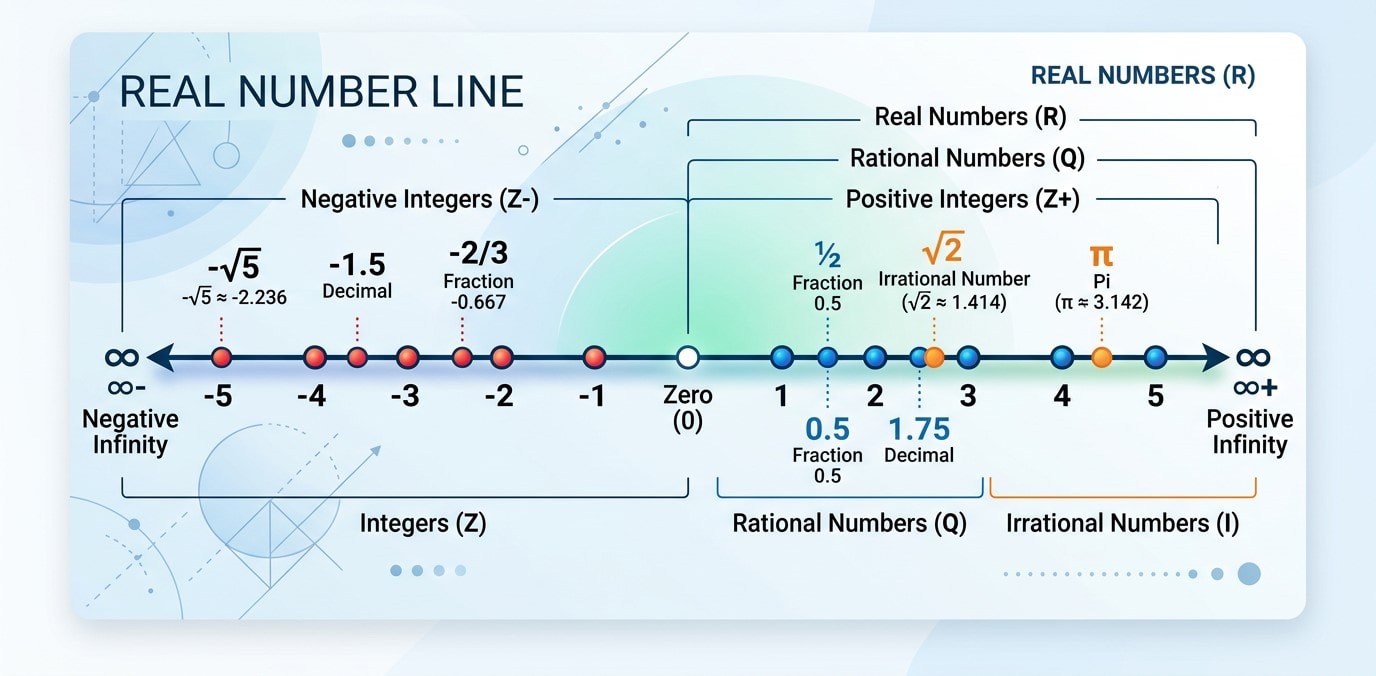
At first glance, a number line looks like a simple tool used in elementary classrooms to teach children how to count, add, and subtract. However, beneath this deceptive simplicity lies one of the most profound, elegant, and fundamental concepts in all of mathematics. The number line is not just a drawing; it is a visual and conceptual bridge that connects the abstract, logical world of numbers to the physical, continuous world of geometry.
In this comprehensive guide, we will explore the number line from its foundational elements to its advanced scientific and mathematical implications. We will examine how different number systems populate this line, how mathematicians resolved historical crises regarding the "gaps" on the line, and how we can represent complex mathematical relationships, such as intervals, using this powerful visual model.
1. The Anatomy of a Number Line
Before we populate the number line with various types of numbers, we must understand its geometric structure. A number line is a straight, horizontal geometric line that extends infinitely in both directions. It consists of three essential components:
The Origin (Zero): A fixed point chosen arbitrarily on the line to represent the number 0. This point acts as the reference benchmark for all other numbers.
Direction: By universal convention, moving to the right of the origin represents positive values (increasing magnitude), while moving to the left represents negative values (decreasing magnitude).
Unit Length: A standard, consistent distance chosen to represent the interval between consecutive integers (e.g., the distance from 0 to 1). This unit length remains uniform across the entire length of the line.
By establishing these three components, we create a coordinate system on a one-dimensional space. Every point on this line can now be uniquely identified by its distance and direction from the origin.
2. Populating the Line: From Natural Numbers to Integers
To understand how the number line works, we must observe how different number systems are placed upon it chronologically and logically. We begin with the most basic numbers known to humanity.
Natural and Whole Numbers
The natural numbers (1, 2, 3, ...) are the counting numbers. When we place them on the number line, we start at the first unit mark to the right of the origin and proceed rightward at equal unit intervals. If we include the origin itself (0), we obtain the set of whole numbers. On the number line, these appear as discrete, equally spaced dots.
The Integers
By mirroring the natural numbers to the left of the origin, we introduce the negative integers (-1, -2, -3, ...). Combined with zero and the positive integers, this complete set forms the Integers. On our visual model, the integers look like an endless chain of perfectly balanced points extending to the left and right of the zero mark. At this stage, every integer has a precise, unambiguous home on the line.
3. Filling the Spaces: The Rational Numbers
While integers are highly useful, they leave massive empty spaces between them. What lies between 1 and 2? To answer this, we introduce the Rational Numbers. A rational number is any number that can be expressed as a fraction p/q, where p and q are integers and q is not equal to 0.
When we plot rational numbers (such as 1/2, -3/4, or 2.5) on the number line, we begin to fill the empty spaces between our discrete integer points. For instance, to locate 1/2, we divide the unit interval between 0 and 1 into two equal segments and mark the boundary. To locate -1.75 (-7/4), we divide the interval between -1 and -2 into four equal parts and count three marks to the left of -1.
The Concept of Density: Rational numbers possess a property known as density. This means that between any two distinct rational numbers, no matter how close they are, there is always another rational number. For example, between 0.1 and 0.2 lies 0.15. Between 0.1 and 0.11 lies 0.105. This process can be repeated infinitely.
Because of this density, one might naturally assume that the rational numbers are sufficient to completely fill the entire number line. It seems logical that if there are infinitely many rational numbers packed infinitely close together, there shouldn't be any "holes" left on the line. However, this assumption is one of the most famous misconceptions in mathematical history.
4. The Discovery of Gaps: Irrational Numbers
In ancient Greece, the followers of Pythagoras believed that all things in the universe could be measured using whole numbers and their ratios (rational numbers). However, this belief was shattered by a geometric discovery: the diagonal of a unit square.
If you construct a square where each side is exactly 1 unit long, the Pythagorean theorem states that the length of the diagonal is the square root of 2 (√2). If you were to take a compass, place its needle at the origin (0) of a number line, open it to the length of this diagonal, and swing it down to intersect the line, the compass would point to a physical location on the line.
Yet, mathematicians proved that √2 cannot be written as a fraction p/q. It is an irrational number. Its decimal expansion (1.41421356...) goes on forever without repeating.
This realization was revolutionary. It meant that even though the rational numbers are infinitely dense, they do not cover every point on the number line. If we only used rational numbers, the number line would be full of microscopic, invisible "holes" or "gaps" corresponding to values like √2, √3, √5, and transcendental numbers like pi (π) and e. These gaps are filled entirely by the irrational numbers.
5. The Real Number Line and the Continuum
To create a complete, unbroken line, we must combine the set of all rational numbers and the set of all irrational numbers. This unified set is known as the Real Numbers.
When we merge these two sets, we achieve a state of mathematical completeness. This leads us to one of the most important axioms in mathematical analysis, established by mathematicians like Richard Dedekind and Georg Cantor:
The One-to-One Correspondence Principle: On a complete real number line, every single point corresponds to exactly one unique real number, and conversely, every real number corresponds to exactly one unique point on the line. There are no gaps, no holes, and no overlaps.
Because of this perfect, seamless mapping, the real number line is often referred to as the real continuum. A real number cannot be both rational and irrational at the same time; it must belong to one category or the other, and together they claim ownership of every coordinate on the continuous line.
6. Representing Subsets of the Real Line: Intervals
Once we establish the continuous real number line, we often need to discuss specific segments or portions of it rather than individual isolated points. These continuous segments are called intervals.
An interval is simply a set of real numbers that contains all real numbers lying between any two specified numbers of the set. To represent these intervals both visually on the number line and symbolically using mathematical notation, we categorize them based on whether their boundary points (endpoints) are included.
A. Closed Intervals
A closed interval includes both of its endpoints. If we want to represent all real numbers x that are greater than or equal to 2, and less than or equal to 5, we write this algebraically as:
2 ≤ x ≤ 5
In interval notation, we use square brackets to indicate that the endpoints are included:
[2, 5]
On the physical number line, we represent this by drawing a solid, filled-in circle at 2 and another solid, filled-in circle at 5, and then shading or thickening the entire line segment between them. This shading visually demonstrates that every single real number in between—including fractions like 9/4 and irrational numbers like √7—is part of the interval.
B. Open Intervals
An open interval excludes both of its endpoints. If we want to represent all real numbers strictly between 2 and 5, but not the numbers 2 and 5 themselves, we write:
2 < x < 5
In interval notation, we use parentheses to denote excluded endpoints:
(2, 5)
On the number line, we model this by drawing open, hollow circles at 2 and 5, and shading the line segment between them. The hollow circles act as visual boundaries, showing that we can get infinitely close to 2 (like 2.00001) or 5 (like 4.99999), but the exact boundary values are excluded.
C. Half-Open (Semi-Open) Intervals
An interval can also include one endpoint while excluding the other. These are called half-open or semi-open intervals. Consider the following examples:
[2, 5): This represents 2 ≤ x < 5. On the number line, 2 has a solid circle, 5 has a hollow circle, and the space between is shaded.
(2, 5]: This represents 2 < x ≤ 5. On the number line, 2 has a hollow circle, 5 has a solid circle, and the space between is shaded.
D. Infinite Intervals and the Concept of Infinity
Some intervals do not stop at a finite boundary but extend indefinitely in one or both directions. To represent this, we introduce the mathematical concept of infinity (∞) and negative infinity (-∞).
It is crucial to remember that infinity is not a real number; it is a concept indicating unbounded growth. Therefore, because infinity cannot be reached or included as an exact numerical endpoint, we always use an open parenthesis next to the infinity symbol in interval notation.
x ≥ 3 is represented as [3, ∞). On the number line, we place a solid circle at 3 and draw a shaded line to the right with an arrow pointing infinitely onward.
x < -1 is represented as (-∞, -1). On the number line, we place a hollow circle at -1 and draw a shaded line extending infinitely to the left.
The entire real number line itself is represented as (-∞, ∞).
7. Operations on Intervals: Overlaps and Intersections
In advanced mathematics, scientific inquiries often require us to look at multiple conditions simultaneously. We can visualize how different intervals interact by modeling them on the same number line.
For example, let's analyze two different intervals: (3, 6) and [-1, 4].
If we draw both intervals on a single number line:
The interval [-1, 4] starts at -1 (included) and ends at 4 (included).
The interval (3, 6) starts at 3 (excluded) and ends at 6 (excluded).
By looking at the visual overlay, we can easily identify the common region where these two intervals overlap. The overlapping segment starts immediately after 3 and ends exactly at 4. Since 3 is excluded from the second interval, it cannot be in the overlapping set. Since 4 is included in both intervals, it is included in the overlap. Thus, the intersection of these two intervals forms a new interval: (3, 4].
8. Key Takeaways
The number line is much more than a basic drawing tool. It is a rigorous geometric representation of the real number system. Let's summarize the key concepts every student should remember:
The Continuum: The number line represents the real number system. There is a perfect, one-to-one correspondence between every point on the line and every real number.
Completeness: Rational numbers alone cannot form a continuous line; they leave infinitely many microscopic gaps. These gaps are filled entirely by irrational numbers.
Visual Intervals: Intervals represent continuous segments of the line. The distinction between closed brackets [ ] (solid dots) and open parentheses ( ) (hollow dots) indicates whether the boundary values are included in the subset.
Infinity: The infinity symbol (∞) is used to represent intervals that extend without bound in either direction, and it is always written with an open parenthesis.
By mastering the number line, you build a solid foundation for algebra, calculus, coordinate geometry, and the physical sciences. It teaches us how to visualize abstract mathematical limits, solve complex inequalities, and conceptualize the infinite, continuous nature of our universe.