How do we calculate the volume of an irregularly shaped three-dimensional object? While classical geometry provides elegant formulas for perfect spheres, cones, and cylinders, real-world objects and advanced scientific models are rarely so uniform. To measure the space enclosed by complex, curved three-dimensional boundaries, we must turn to the power of calculus.
Definite integration allows us to break down a complex three-dimensional solid into infinite, infinitesimally thin slices, calculate the volume of each slice, and sum them up to find the exact total volume. This article provides a rigorous, step-by-step guide to the mathematical theory, practical methods, and physical applications of volume computation using definite integrals.
1. The Foundation: The Slicing Method
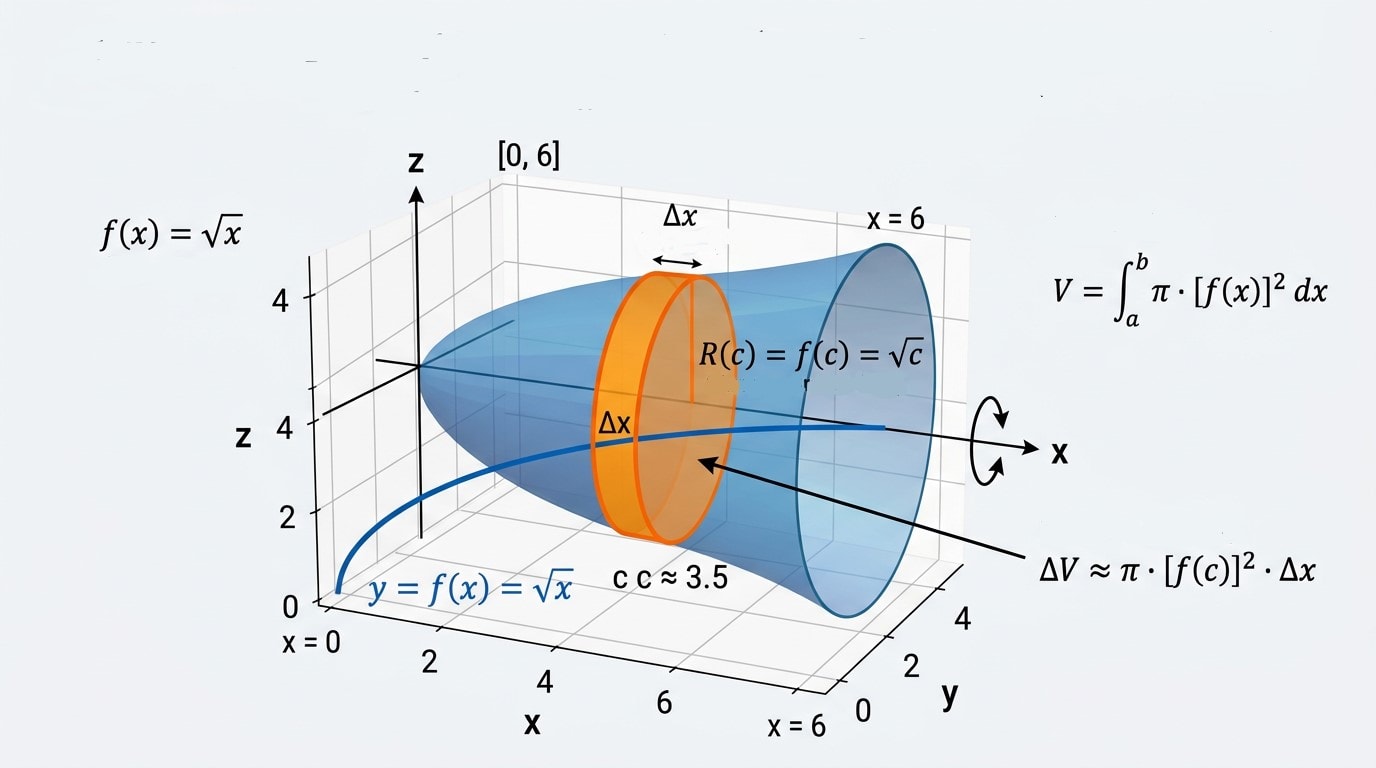
The fundamental principle behind computing volumes with integration is the Slicing Method. This is a direct extension of how we find the area under a curve using Riemann sums. Instead of dividing a two-dimensional area into thin rectangles, we divide a three-dimensional solid into thin slices.
Imagine a solid object positioned along the x-axis, spanning from x = a to x = b. If we cut through the solid with a plane perpendicular to the x-axis at a specific point x, the resulting cross-section will have a measurable area, which we can define as a function of x, denoted as A(x).
To approximate the total volume of this solid:
We divide the interval [a, b] into n subintervals, each of width Δx.
In each subinterval, we choose a sample point x_i.
The volume of the thin slice at x_i is approximately the cross-sectional area multiplied by the thickness: V_i ≈ A(x_i) · Δx.
The total volume is the sum of these slices: V ≈ Σ A(x_i) · Δx.
Taking the limit as the number of slices approaches infinity (and the thickness Δx approaches zero), this Riemann sum transforms into a definite integral:
The General Volume Formula:
V = ∫ab A(x) dx
This general slicing formula is highly versatile because it does not require the solid to be symmetric or circular. As long as we can express the cross-sectional area A(x) as a continuous function of x, we can calculate the volume.
2. Solids of Revolution: The Disk Method
One of the most common applications of the slicing method occurs when a solid is generated by rotating a two-dimensional region around a straight line, known as the axis of revolution. Such solids are called solids of revolution.
When a region bounded by a curve y = f(x), the x-axis, and the vertical lines x = a and x = b is rotated 360 degrees around the x-axis, every cross-section perpendicular to the x-axis is a perfect circular disk.
The radius of the disk at any point x is simply the height of the function, r = f(x). Since the area of a circle is π · r², the cross-sectional area function is:
A(x) = π · [f(x)]²
Substituting this into our general slicing formula yields the Disk Method Formula:
The Disk Method (Rotation about the x-axis):
V = π · ∫ab [f(x)]² dx
Example: Deriving the Volume of a Sphere
Let us use the disk method to derive the classic geometric formula for the volume of a sphere of radius R. A sphere can be generated by rotating the upper half of a circle centered at the origin around the x-axis. The equation of this circle is x² + y² = R², which gives the function:
y = f(x) = √(R² - x²) on the interval [-R, R].
Applying the disk method:
V = π · ∫-RR [√(R² - x²)]² dx
V = π · ∫-RR (R² - x²) dx
Since the integrand is an even function, we can simplify the limits of integration from [0, R] and multiply by 2:
V = 2π · [ R²x - (x³ / 3) ] evaluated from 0 to R
V = 2π · [ (R³ - R³ / 3) - 0 ]
V = 2π · [ 2R³ / 3 ] = (4/3) · π · R³
This elegant derivation confirms the power and accuracy of definite integration in volume computation.
3. Dealing with Hollow Solids: The Washer Method
What happens if the two-dimensional region we rotate does not touch the axis of revolution? This creates a hollow space in the center of the solid. When we slice this solid perpendicular to the axis of revolution, the cross-sections are not solid disks, but flat rings or washers.
A washer has an outer radius, R(x), determined by the upper boundary curve, and an inner radius, r(x), determined by the lower boundary curve. The area of a washer is the area of the outer circle minus the area of the inner hole:
A(x) = π · [R(x)]² - π · [r(x)]² = π · ([R(x)]² - [r(x)]²)
Integrating this area function gives us the Washer Method Formula:
The Washer Method:
V = π · ∫ab ([R(x)]² - [r(x)]²) dx
Note: It is a common mistake to write the integrand as [R(x) - r(x)]². Remember that you must square the individual radii first before subtracting them: [R(x)]² - [r(x)]².
4. An Alternative Perspective: The Cylindrical Shells Method
Sometimes, slicing perpendicular to the axis of revolution leads to highly complex integrals, or require us to solve difficult equations to express x in terms of y. In such cases, we can slice the solid parallel to the axis of revolution using the Cylindrical Shells Method.
Instead of flat disks, we approximate the solid using nested, thin cylindrical shells (like the layers of an onion). When we unroll a thin cylindrical shell of radius r, height h, and thickness Δx, it forms a flat rectangular sheet with a volume of:
V_shell ≈ 2π · radius · height · thickness = 2π · r · h · Δx
If we rotate a region bounded by y = f(x) and the x-axis from x = a to x = b around the y-axis, the radius of a shell at any point x is simply x, and its height is f(x). Integrating these shells gives:
The Cylindrical Shells Method (Rotation about the y-axis):
V = 2π · ∫ab x · f(x) dx
5. Choosing the Right Method
Selecting the most efficient integration method is key to solving volume problems. Use the following guidelines to decide which method to apply:
Identify the Axis of Revolution: Determine if you are rotating around a horizontal axis (like the x-axis) or a vertical axis (like the y-axis).
Determine the Orientation of your Slices:
If you slice perpendicular to the axis of revolution, use the Disk/Washer Method.
If you slice parallel to the axis of revolution, use the Cylindrical Shells Method.
Analyze the Boundaries: If expressing the equations in terms of y is difficult, but easy in terms of x, choose the method that lets you integrate with respect to x.
Summary of Formulas
The table below summarizes the integration setups for different axes of revolution:
Rotation around Horizontal Axis (e.g., x-axis):
Disk/Washer (integrate dx): V = π · ∫ [R(x)² - r(x)²] dx
Shells (integrate dy): V = 2π · ∫ y · g(y) dy
Rotation around Vertical Axis (e.g., y-axis):
Disk/Washer (integrate dy): V = π · ∫ [R(y)² - r(y)²] dy
Shells (integrate dx): V = 2π · ∫ x · f(x) dx
Conclusion
Computing volumes using definite integration is a beautiful demonstration of how calculus bridges the gap between simple planar geometry and complex spatial dimensions. By understanding the physical intuition of slicing—whether into flat disks, hollow washers, or concentric cylindrical shells—you can systematically break down and solve even the most intricate volume problems in physics, engineering, and mathematics.