


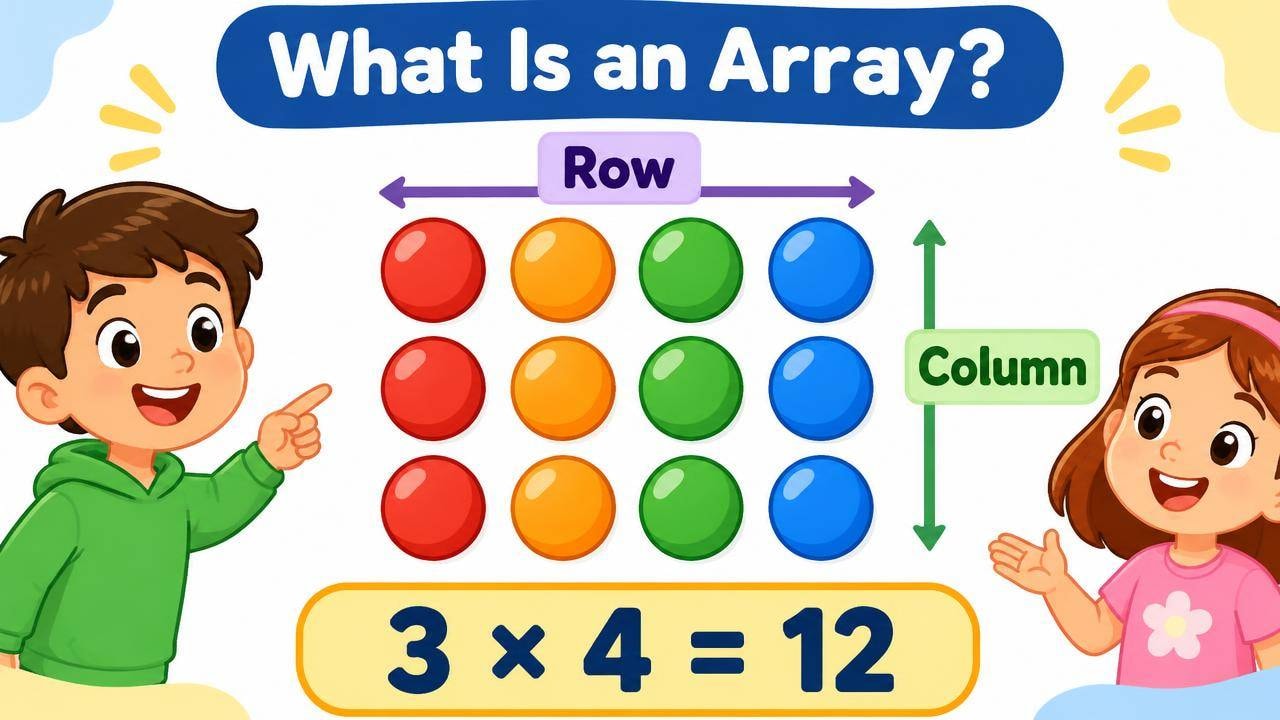
Have you ever seen chairs lined up neatly or muffins sitting in a baking tray? When objects are arranged in equal rows and columns, they form an array. Arrays help us count, recognize patterns, and begin to understand multiplication.
Rows and Columns
An array is a way to arrange objects in straight rows and columns. Each row has the same number of objects, and each column has the same number of objects.
- Rows go across, from side to side.
- Columns go up and down.
Look at This Array
● ● ● ●
● ● ● ●
● ● ● ●
Imagine these dots arranged in three straight rows with four dots in each row. There are also four columns with three dots in each column.
There are 12 dots altogether. You can count each dot, but the equal rows give you other ways to find the total.
Count Equal Rows
Because every row has the same number of objects, you can count one row at a time.
Try Skip-Counting
For our array of three rows with four dots in each row, count by fours:
- The first row has 4 dots.
- The first two rows have 8 dots altogether.
- All three rows have 12 dots altogether.
Say the numbers aloud: 4, 8, 12!
Use Repeated Addition
You can also add the number of dots in each row:
4 + 4 + 4 = 12
This is called repeated addition because you add the same number more than once.
How Arrays Show Multiplication
Multiplication is a way to find the total in equal groups. In an array, each row can be one equal group.
Three rows with four dots in each row means 3 groups of 4. We can write:
3 × 4 = 12
The symbol × means “times.” Read the equation as “three times four equals twelve.”
For these examples, the first number tells how many rows there are. The second number tells how many objects are in each row.
Another Example: Toy Cars
Arrange toy cars in 2 rows with 5 cars in each row.
- Count by fives: 5, 10.
- Add the rows: 5 + 5 = 10.
- Multiply: 2 × 5 = 10.
There are 10 toy cars altogether. Each method gives the same total.
Is Every Group an Array?
No. A scattered pile of objects is not an array. For the rectangular arrays we are learning about, the objects must line up in straight rows and columns, with an equal number in every row.
Check the Arrangement
- Three straight rows with four buttons in each row form an array.
- Two straight rows with six blocks in each row form an array.
- A row of three counters above a row of five counters does not form a complete rectangular array.
If a row has too many or too few objects, try moving the objects to make equal rows.
Turn an Array Around
Build an array with 2 rows of 3 counters. It has 6 counters altogether.
Now turn the whole array so that its rows become columns. You will see 3 rows of 2 counters. There are still 6 counters!
- 2 × 3 = 6
- 3 × 2 = 6
Turning the array changes how you see the rows and columns, but it does not change the total number of objects.
Build Your Own Array
Gather 12 counters, blocks, or paper squares. Try this activity:
- Make 3 straight rows with 4 objects in each row.
- Point to each row and count: 4, 8, 12.
- Write the addition equation: 4 + 4 + 4 = 12.
- Write the multiplication equation: 3 × 4 = 12.
- Rearrange the same objects into 2 rows with 6 in each row.
- Check that the total is still 12.
Challenge: Can you arrange all 12 objects in one straight row? How many objects are in that row?
Quick Practice
- An array has 2 rows with 4 stars in each row. How many stars are there?
- An array has 3 rows with 2 buttons in each row. What repeated addition equation matches it?
- An array has 4 rows with 3 blocks in each row. What multiplication equation matches it?
Check Your Answers
- 8 stars: 4 + 4 = 8, so 2 × 4 = 8.
- 2 + 2 + 2 = 6: There are 6 buttons.
- 4 × 3 = 12: There are 12 blocks.
Key Takeaways
- An array arranges objects in equal rows and columns.
- Rows go across. Columns go up and down.
- You can find the total by counting, skip-counting, or using repeated addition.
- Multiplication is a shorter way to describe equal groups.
- Turning an array does not change its total.
Look around for arrays in windows, floor tiles, or trays. Count the rows and the objects in each row. What multiplication equation could you write?