


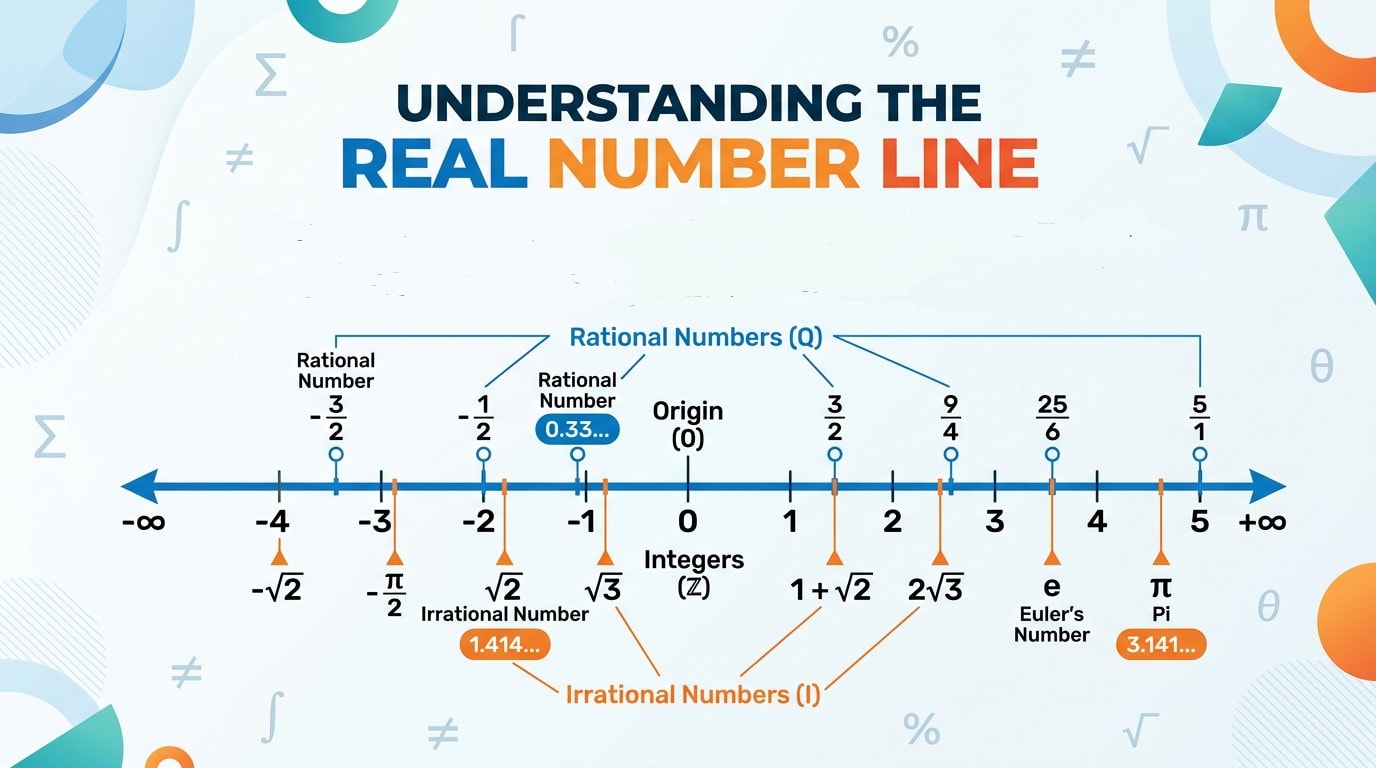
While we begin our mathematical journey with simple counting numbers, the full scope of physical reality requires a much richer system: the real number system. From measuring the precise diagonal of a square to tracking continuous changes in time and space, real numbers are indispensable.
In this comprehensive guide, we will explore the properties of real numbers, how they map perfectly to the geometric concept of a number line, and how we can represent groups of these numbers using intervals. Whether you are a student looking to master your algebra foundations or a curious mind seeking to understand the mathematical continuum, this article will cover everything you need to know.
The Evolution of the Real Number System
To truly understand real numbers, we must first look at how they are built. The system of real numbers (denoted by the symbol ℝ) is a nested hierarchy of different number sets. Let's trace this development from the simplest to the most complex:
Natural Numbers (ℕ): These are our basic counting numbers: {1, 2, 3, 4, ...}. They are the first numbers humanity developed.
Whole Numbers: By adding zero {0} to the set of natural numbers, we get the whole numbers: {0, 1, 2, 3, ...}.
Integers (ℤ): When we introduce negative values to represent debts or opposite directions, we get integers: {..., -3, -2, -1, 0, 1, 2, 3, ...}. Note that every natural number is also an integer.
Rational Numbers (ℚ): These are numbers that can be expressed as a fraction (or ratio) of two integers, written in the form p/q, where p and q are integers and q is not equal to zero. Examples include 1/2, -3/4, and 5 (which can be written as 5/1).
This brings us to a crucial question that mathematicians pondered for centuries: Does every single point on a continuous line correspond to a rational number?
Filling the Gaps: Rational vs. Irrational Numbers
Imagine a perfectly straight, infinitely long line. If we place all rational numbers on this line, it might seem like we have filled it completely. After all, between any two rational numbers, no matter how close, there is always another rational number (a property known as the density of rational numbers).
However, the shocking truth is that rational numbers do not fill the number line. If we only used rational numbers, the line would be full of microscopic, yet infinite, "holes." These holes correspond to lengths that cannot be expressed as a simple fraction. We call these irrational numbers.
What is an Irrational Number? An irrational number is a number that cannot be written as a simple fraction of two integers. Their decimal expansions are non-terminating and non-repeating. Famous examples include the square root of 2 (√2) and the mathematical constant pi (π).
By combining the set of all rational numbers and the set of all irrational numbers, we form the set of Real Numbers. In this system:
A number can be rational or irrational, but never both.
The real numbers completely fill the number line, leaving absolutely no gaps.
The Real Number Line and the One-to-One Correspondence
One of the most beautiful and fundamental properties of real numbers is their geometric representation on a continuous line, known as the real number line.
Because real numbers combine both rational and irrational numbers to fill every possible gap, we arrive at a powerful mathematical conclusion:
The Principle of Completeness: To every point on the number line, there corresponds one and only one real number; and conversely, to every real number, there corresponds one and only one point on the number line.
When we place real numbers on this line, we can easily visualize their order and estimate the positions of irrational numbers. For instance, since we know that √4 = 2 and √9 = 3, we can estimate that √5 must lie somewhere between 2 and 3 (approximately 2.236). This allows us to pinpoint its approximate location on our physical number line.
Algebraic Properties of Real Numbers
Beyond their geometric representation, real numbers obey a strict set of algebraic rules. These properties form the basis of all algebraic manipulations and equation-solving techniques.
1. Closure Properties
If you add or multiply any two real numbers, the result will always be a real number. For any real numbers a and b, both a + b and a × b are real numbers.
2. Commutative Properties
The order in which we add or multiply two real numbers does not change the result:
Addition: a + b = b + a
Multiplication: a × b = b × a
3. Associative Properties
When adding or multiplying three real numbers, the way we group them does not affect the outcome:
Addition: (a + b) + c = a + (b + c)
Multiplication: (a × b) × c = a × (b × c)
4. Identity Properties
There exist unique real numbers that leave other numbers unchanged when operated upon:
Additive Identity (0): a + 0 = a
Multiplicative Identity (1): a × 1 = a
5. Inverse Properties
Every real number has an opposite that "undoes" its value:
Additive Inverse: For every real number a, there is a unique real number -a such that a + (-a) = 0.
Multiplicative Inverse: For every non-zero real number a, there is a unique real number 1/a such that a × (1/a) = 1.
6. Distributive Property
Multiplication distributes over addition: a × (b + c) = (a × b) + (a × c).
Understanding Real Number Intervals
In practical mathematics, we often need to talk about a whole segment of the number line rather than just single, isolated numbers. For example, how do we express "all the real numbers between 2 and 5"? Since there are infinitely many real numbers between any two points, we cannot write them as a list. Instead, we use intervals.
An interval is a set of real numbers that contains all the real numbers lying between any two numbers of the set. We classify these intervals based on whether their boundary points (endpoints) are included or excluded.
Closed Intervals
A closed interval includes both of its endpoints. We represent this using square brackets.
If we want to represent all real numbers x that are greater than or equal to 2, and less than or equal to 5, we write:
Inequality Notation: 2 ≤ x ≤ 5
Interval Notation: [2, 5]
On a number line, this is modeled by drawing solid, filled-in circles at 2 and 5, with a thick line connecting them.
Open Intervals
An open interval excludes both endpoints. We represent this using parentheses.
If we want to represent all real numbers x strictly between 2 and 5, excluding 2 and 5 themselves, we write:
Inequality Notation: 2 < x < 5
Interval Notation: (2, 5)
On a number line, this is modeled using open (hollow) circles at 2 and 5.
Half-Open (or Half-Closed) Intervals
Sometimes, only one of the endpoints is included. We use a combination of brackets and parentheses:
[2, 5) represents 2 ≤ x < 5 (2 is included, 5 is excluded).
(2, 5] represents 2 < x ≤ 5 (2 is excluded, 5 is included).
Infinite Intervals and the Concept of Infinity
Some intervals go on forever in one or both directions. We use the infinity symbol (∞) or negative infinity (-∞) to represent these unbounded limits. Because infinity is a concept and not a reachable real number, we always use a parenthesis next to the infinity symbol.
x ≥ a is represented as [a, ∞)
x > a is represented as (a, ∞)
x ≤ a is represented as (-∞, a]
x < a is represented as (-∞, a)
Working with Multiple Intervals
In advanced algebra, we often compare or combine different sets of real numbers. Let's look at a practical example of finding the overlapping region (intersection) of two different intervals.
Imagine we have two intervals representing two different sets of numbers:
Interval A: (-1, 4] (all numbers greater than -1 up to and including 4)
Interval B: (3, 6) (all numbers strictly between 3 and 6)
If we draw both of these intervals on the same number line, we can easily see where they overlap. The numbers that belong to both intervals are those that are greater than 3 but less than or equal to 4. Therefore, the intersection of these two intervals can be written as a new interval:
Intersection: (3, 4]
Key Takeaways
The Continuum: Real numbers consist of all rational and irrational numbers, forming a complete system with zero gaps.
One-to-One Correspondence: Every point on the physical number line represents exactly one real number, and vice versa.
Intervals: We use intervals to represent continuous segments of the number line. Brackets [ ] mean the endpoints are included (closed), while parentheses ( ) mean they are excluded (open).
Algebraic Rules: Real numbers obey fundamental laws of arithmetic, including the commutative, associative, distributive, identity, and inverse properties.